afrol News, 3 November - Equatoguinean President Teodoro Nguema Obiang today issued a decree pardoning the five foreign masterminds behind an alleged coup attempt in March 2004. These include South African Nicolaas du Toit and Briton Thomas Mann, who will be freed during few days.
In two decrees, sent to afrol News by Equatoguinean government officials, President Obiang orders the pardoning, release and expulsion of the five foreigners sentenced in June 2008 and held in Malabo prisons since their arrest in 2004.
A government statement says the release of the foreign coup plotters comes in relation with the official state visit of South African President Jacob Zuma to Equatorial Guinea starting tomorrow. Equatoguinean spokesperson Nuria Blasco told afrol News the timing of the decree was made as a gesture to South African President Zuma.
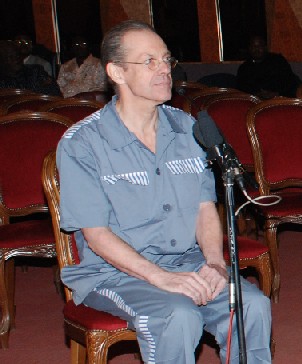
The Equatoguinean government today made public two decrees signed yesterday by President Obiang. The first decree is exclusively dedicated to the Briton Simon Mann (57), who during the 2008 court case confessed - allegedly following heavy torture - his key role in the alleged attempt to dethrone Equatorial Guinea's totalitarian president.
The decree referring to Mr Mann issues "a total pardoning for humanitarian reasons" of the Briton. Mr Mann's "health situation" and his "need to be regularly submitted to medical treatment" were outlined as the main reason for him being freed. While Equatoguinean judicial sources maintain he is now in good health following a hernia operation in 2008, the harsh conditions in Equatoguinean jails are seen as a constant risk to inmates' lives.
Once freed, Mr Mann was ordered to leave Equatorial Guinea, heading for Britain, within 24 hours. The Briton is denied access to the Central African country for the rest of his life. Judicial sources in Malabo indicate that Mr Mann will be freed tomorrow or on Thursday.
The following decree by President Obiang is directed towards four South African citizens; Nicolaas du Toit, Sergio Patricion Cardoso, Jose Passocas Domingos and George Núñez Alerson. All four were convicted to 17 years imprisonment in 2008 for being mercenaries participating in the alleged 2004 coup.
Also the four South Africans were pardoned on "humanitarian reasons", having in mind "the long time of imprisonment and the need to restart their lives." All had conducted well in imprisonment and "given credible evidence of their remorse."
The four South Africans were also ordered to leave Equatorial Guinea within 24 hours after their release and return directly to their home country. Upon arrival in South Africa, however, they may have to answer to the South African justice as national laws strictly forbid mercenary activities. Another imprisonment term may therefore expect them at home.
Equatoguinean authorities maintain that Mr Mann, Mr du Toit and their alleged mercenaries only were the men leading ground operations in the coup plot. Leaning on evidence given by Mr Mann, Mark Thatcher, son of Britain's former Prime Minister Margaret Thatcher, had been the mastermind, together with Equatoguinean exiled leaders living in Spain. Mr Thatcher, maintaining his innocence, is wanted by Equatoguinean courts and fined by the South African justice.
The announcement of the pardoning of the 2004 coup plotters came as a surprise to both the imprisoned and their families. It is believed that the South African presidency has lobbied to secure their release before the otherwise surprising visit of President Zuma to Equatorial Guinea.
The pardon however only includes foreign accomplices to the alleged coup plot. A large number of Equatoguineans were also imprisoned in the aftermaths of the alleged coup plot in what was seen as yet another pogrom against the country's opposition.
The number of political prisoners in Equatorial Guinea remains high and there is still no room for true opposition in the country, which has been ruled by Mr Obiang since 1979. Mr Obiang in turn toppled his uncle, President Macias Nguema, in a 1979 coup and had him killed.
afrol News - It is called "financial inclusion", and it is a key government policy in Rwanda. The goal is that, by 2020, 90 percent of the population is to have and actively use bank accounts. And in only four years, financial inclusion has doubled in Rwanda.
afrol News - The UN's humanitarian agencies now warn about a devastating famine in Sudan and especially in South Sudan, where the situation is said to be "imploding". Relief officials are appealing to donors to urgently fund life-saving activities in the two countries.
afrol News - Fear is spreading all over West Africa after the health ministry in Guinea confirmed the first Ebola outbreak in this part of Africa. According to official numbers, at least 86 are infected and 59 are dead as a result of this very contagious disease.
afrol News - It is already a crime being homosexual in Ethiopia, but parliament is now making sure the anti-gay laws will be applied in practical life. No pardoning of gays will be allowed in future, but activist fear this only is a signal of further repression being prepared.
afrol News / Africa Renewal - Ethiopia's ambitious plan to build a US$ 4.2 billion dam in the Benishangul-Gumuz region, 40 km from its border with Sudan, is expected to provide 6,000 megawatts of electricity, enough for its population plus some excess it can sell to neighbouring countries.










 front page
| news
| countries
| archive
| currencies
| news alerts login
| about afrol News
| contact
| advertise
| español
front page
| news
| countries
| archive
| currencies
| news alerts login
| about afrol News
| contact
| advertise
| español