See also:
» 11.03.2011 - African Union praises Ghaddafi "reform offer"
» 01.02.2011 - New AU leader Obiang calls criticism un-African
» 31.01.2011 - Africa's worst dictator becomes AU leader
» 23.04.2010 - World Bank funding targets Africa’s malaria fight
» 26.03.2010 - Aid tied to service delivery still best, WB
» 17.03.2010 - Don’t despair MDGs reachable, Ban
» 17.03.2010 - Trade experts discuss ways to help poor countries
» 04.03.2010 - Africa’s green energy under-exploited


Africa | Equatorial Guinea | Libya
Politics | Society | Human rights

Africa defies AU chief's support for Ghaddafi

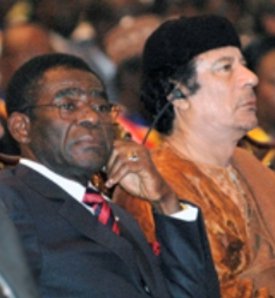
Equatoguinean President Obiang and Libyan leader Ghaddafi at an EU-African summit

© EU/afrol News
afrol News, 18 March
- African Union (AU) chief and Equatorial Guinea dictator Teodoro Obiang Nguema twice has called Colonel Ghaddafi to secure AU support. But other African countries rather support Libya's rebels.

AU leader and lifetime President Obiang has banned all reporting about the revolutions in North Africa in his own country and has denied authorisation for pro-democracy protests in Equatorial Guinea, planned for 23 March.

Also within the AU, he has worked to stop any potential support for the protest movements in North Africa and beyond. Reform demands must be made "within an atmosphere of order and discipline so as not to develop into rebellions and civil disobedience," President Obiang said in a speech this week.

Last week, following a longer phone call between President Obiang and Colonel Ghaddafi, the AU expressed support for the Ghaddafi regime, praising its "readiness" for "political reforms." In a strong statement, the AU said it was firm in "its rejection of any form of foreign military intervention," including a no-fly zone.

Yesterday, before the UN Security Council with the support of African member countries approved of military action against the Ghaddafi regime, President Obiang again phoned with the Libyan leader, afrol News has learnt.

The two old friends spoke about means to demonstrate Libyan cooperation with the international community by preparing for an AU "panel of five heads of state" to "investigate" the peace and security situation in Libya and "help negotiate a peace agreement between the Libyan government and the rebels."

Colonel Ghaddafi allegedly thanked President Obiang for helping to get the AU involved in a positive way. He further promised to "pay all expenses" of the AU mission to Libya and provide any needed facilities.

However, Africa's mostly democratic states no longer believed in the AU leader's flirting with the Ghaddafi regime, it turned out last night.

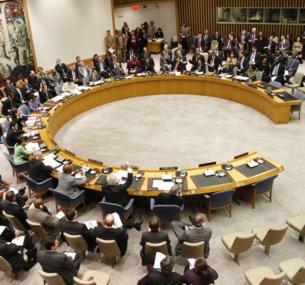
At the UN Security Council, no continent showed greater unity in its support for military action against the Ghaddafi regime. Current African Council

UN Security Council approving military actions against Libya

© Paulo Filgueiras/UN Photo/afrol News
members Gabon, Nigeria and South Africa all voted in favour of the historic resolution, giving an ample mandate to attack the Ghaddafi regime with anything but ground forces.

There had been much doubt about how African members of the Security Council would vote, especially given the AU resolution opposing a no-fly zone over Libya. This resolution in theory would oblige the three African Security Council members to vote against the resolution.

But South Africa's President Jacob Zuma earlier this week indeed made it clear he was favouring the protesters. "Exile, torture, jail or even killing did not succeed to stop the masses of South Africa from demanding their freedom and cannot succeed anywhere else. The recently erupted and massive protests happened because people were tired of autocratic governments which had been there for a long time," President Zuma said.

More surprising was the active vote of Gabon to protect Libyan civilians against the Ghaddafi regime. Gabonese President Ali Bongo himself faces a small but persistent protest movement. Gabon however is strongly tied to France, which was the strongest advocate of the UN resolution.

The anti-Ghaddafi vote of the Nigerian government, on the other side, did not come as a surprise. Nigerian officials at several occasions have uttered outrage at Colonel Ghaddafi's actions and proposals, at latest when the Libyan leader proposed to split Nigeria in two halves; one Christian south and one Muslim north.

But the anti-Ghaddafi mood is widespread in much of Africa, from mostly democratic West Africa, throughout Arab North Africa and to most Southern African countries.

Only AU leader Obiang and the AU's Peace and Security Council still stand behind the Libyan leader. President Obiang because he is against popular uprisings in general; the Council because Ghaddafi's Libya is a leader member of it.


- Create an e-mail alert for Africa news
- Create an e-mail alert for Equatorial Guinea news
- Create an e-mail alert for Libya news
- Create an e-mail alert for Politics news
- Create an e-mail alert for Society news
- Create an e-mail alert for Human rights news


    Printable version

On the Afrol News front page now


UN will not monitor human rights in Western Sahara

afrol News - The US has backed down on its demand that UN peacekeepers in Moroccan-occupied Western Sahara also shall monitor the human rights situation after Moroccan sources threatened to scale down relations with Washington.
Central African Republic
Central African Republic falling apart

afrol News - One month after the rebel movement Séléka took over power in the Central African Republic, unrest is spreading in the country. The new leader lacks control of his forces, which continue looting and abusing civilians.
Kenya
Kenyatta secures tight victory in Kenya

afrol News - The official election results in Kenya have finally been announced, and Uhuru Kenyatta managed to win the first poll round outright with a narrow 50.7 percent. But the main opponent, PM Raila Odinga, is filing a vote rigging complaint to the courts.
Cape Verde
Cape Verde to produce dragon fruit

afrol News - Cape Verde authorities have invested large sums to diversify the arid country's agricultural sector. Now, the dragon fruit, originating in tropical America, is being introduced for the first commercial production in Africa.
Egypt
Even governors in Pharaonic Egypt died in their 20s

afrol News - Researchers have analysed more than 200 mummies from ancient Egypt, finding that even high dignitaries were poorly nourished and had infectious diseases. The typical governor in Pharaonic Egypt died before he was 30 years old.


front page | news | countries | archive | currencies | news alerts login | about afrol News | contact | advertise | español 

©  afrol News. Reproducing or buying afrol News' articles.

   You can contact us at mail@afrol.com