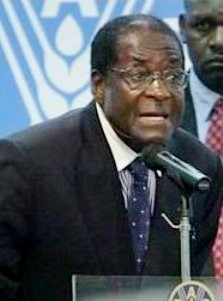
afrol News, 15 April - Depending on which side of the law one is, the so-called indigenisation law in Zimbabwe has been suspended. But, that is not according to President, Robert Mugabe: "Laws are made to be effected and not shelved."
Mr Mugabe has dismissed as false claims, statements that the black empowerment law which was supposed to be effective today, is no more, saying it is only being delayed for more technical cabinet consultations.
The opposition coalition member of government had announced yesterday that the controversial law had been suspended to allow more consultations and inclusion of views from all stakeholders.
This was seen as a desperate bid by the ailing Zimbabwean unity government to amass international support and show a humanitarian face in its economic recovery programme, but since President Mugabe's response, more doubts have been cast on any progress that could be achieved by the unity government formed last February.
The new law, would make it illegal for foreign companies, foreigners as well as Zimbabwean whites to own more than 49 percent or majority stake in companies operating in Zimbabwe, unless such companies are only valued at less than US$ 325,000.
The law, which was passed two years ago in President Mugabe's ZANU-PF dominated parliament is said to be a way of empowering indigenous Zimbabweans, that excludes the white minority, born and brought up in the same country.
The controversial law also follows on the farm seizures in Zimbabwe, which forced white farmers out of their land, a move that has largely been blamed to cause the economic crisis that sunk Zimbabwe to its lowest deep about two years ago.
Zimbabwe, which gained independence in 1980 from Britain, was once Southern Africa's economic hub, but has since relegated itself to a mere economic shame and begging nation, after years of ill-advised economic and political policies.
Refusal by President Mugabe to step down even after an impressive challenge by the opposition, saw the country plunge further to a hyperinflation never seen before and a humanitarian crisis that caught the world's attention.
afrol News - It is called "financial inclusion", and it is a key government policy in Rwanda. The goal is that, by 2020, 90 percent of the population is to have and actively use bank accounts. And in only four years, financial inclusion has doubled in Rwanda.
afrol News - The UN's humanitarian agencies now warn about a devastating famine in Sudan and especially in South Sudan, where the situation is said to be "imploding". Relief officials are appealing to donors to urgently fund life-saving activities in the two countries.
afrol News - Fear is spreading all over West Africa after the health ministry in Guinea confirmed the first Ebola outbreak in this part of Africa. According to official numbers, at least 86 are infected and 59 are dead as a result of this very contagious disease.
afrol News - It is already a crime being homosexual in Ethiopia, but parliament is now making sure the anti-gay laws will be applied in practical life. No pardoning of gays will be allowed in future, but activist fear this only is a signal of further repression being prepared.
afrol News / Africa Renewal - Ethiopia's ambitious plan to build a US$ 4.2 billion dam in the Benishangul-Gumuz region, 40 km from its border with Sudan, is expected to provide 6,000 megawatts of electricity, enough for its population plus some excess it can sell to neighbouring countries.










 front page
| news
| countries
| archive
| currencies
| news alerts login
| about afrol News
| contact
| advertise
| español
front page
| news
| countries
| archive
| currencies
| news alerts login
| about afrol News
| contact
| advertise
| español