afrol News, 15 April - The quick eviction of more than 50,000 people living alongside Kenya's railways is being considered by the Nairobi government. Rights groups urge authorities to adopt "guidelines that conform with international human rights standards" before considering evictions.
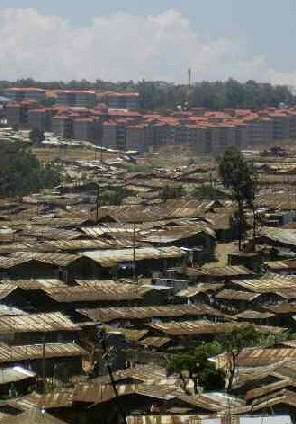
On 21 March, Kenya Railways published a notice giving residents 30 days to pull down their structures and leave, or risk prosecution. Most of those affected are slum dwellers in parts of Nairobi. Now, government is considering if and how to implement this eviction order.
There are no sure estimates about the number of people being affected by the evictions. But a study commissioned by the Kenyan government in 2005 concluded that 50,000 people or more live or work within the Kenya Railway reserve in Nairobi alone and many thousands more use the tracks as a walking route to and from their residences. This population is likely to have increased since 2005.
Human rights groups today strongly protested the ample eviction plans. "People have been living and working on these lands for years and a thirty-day notice period is wholly inadequate," said Justus Nyang'aya, Director of Amnesty International Kenya.
"Without proper safeguards the proposed mass evictions will have a devastating impact on people's access to water, sanitation, food and schools and could well create a humanitarian emergency," Mr Nyang'aya added. "They will result in forced evictions, which contravene Kenya's obligations under international human rights laws."
While it is recognised that the Kenyan government is taking important steps to upgrade its railway system, for the tens of thousands of people living in the affected area, the demolition of homes and informal businesses is expected to be "socially and economically disastrous," according to the human rights group.
To date, no comprehensive resettlement or compensation plan has been announced and the government appears to have made no provision for those who will lose their homes, livelihoods, possessions and social networks as a result of the project.
Amnesty holds that, under international human rights law, "evictions should only be carried out as a last resort and only after all other feasible alternatives to eviction have been explored in genuine consultation with affected communities." Governments were also said to be "obliged to ensure that no one is rendered homeless or vulnerable to the violation of other human rights as a consequence of eviction."
"Kenya's government is failing to deliver on its promise to put in place guidelines which comply with international human rights law regarding evictions and until it does it should halt all mass evictions of this nature," said Mr Nyang'aya. "To put 50,000 of your poorest and most vulnerable citizens at risk of homelessness is unacceptable," he added.
afrol News - It is called "financial inclusion", and it is a key government policy in Rwanda. The goal is that, by 2020, 90 percent of the population is to have and actively use bank accounts. And in only four years, financial inclusion has doubled in Rwanda.
afrol News - The UN's humanitarian agencies now warn about a devastating famine in Sudan and especially in South Sudan, where the situation is said to be "imploding". Relief officials are appealing to donors to urgently fund life-saving activities in the two countries.
afrol News - Fear is spreading all over West Africa after the health ministry in Guinea confirmed the first Ebola outbreak in this part of Africa. According to official numbers, at least 86 are infected and 59 are dead as a result of this very contagious disease.
afrol News - It is already a crime being homosexual in Ethiopia, but parliament is now making sure the anti-gay laws will be applied in practical life. No pardoning of gays will be allowed in future, but activist fear this only is a signal of further repression being prepared.
afrol News / Africa Renewal - Ethiopia's ambitious plan to build a US$ 4.2 billion dam in the Benishangul-Gumuz region, 40 km from its border with Sudan, is expected to provide 6,000 megawatts of electricity, enough for its population plus some excess it can sell to neighbouring countries.










 front page
| news
| countries
| archive
| currencies
| news alerts login
| about afrol News
| contact
| advertise
| español
front page
| news
| countries
| archive
| currencies
| news alerts login
| about afrol News
| contact
| advertise
| español