See also:
» 10.02.2011 - Wave of strikes could bring Mubarak down
» 19.04.2010 - Mitsubishi to fight Egyptian company in court
» 11.02.2010 - Egypt opens country’s investment potential
» 14.12.2009 - World Bank chief end Egyptian visit on positive note
» 10.12.2009 - Algeria’s energy firm to go into joint venture
» 20.11.2009 - Algeria-Egypt’s World Cup place explodes into a diplomatic war
» 16.11.2009 - Increased Internet access to boost economic growth, forum
» 10.11.2009 - China-Africa commitments applauded


Egypt | Ethiopia | Sudan | Uganda
Economy - Development | Politics | Environment - Nature

Nile water resource dispute splits region

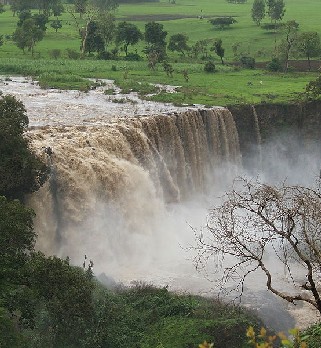
Majestic falls of the Blue Nile in Ethiopia

© Giustino/Flickr/afrol News
afrol News, 14 May
- Ethiopia, Uganda, Tanzania and Rwanda have signed a controversial deal to regulate and share the waters of River Nile, despite protests from downstream nations Sudan and Egypt. Ethiopia at the same time opened its first major dam on the Nile.

The countries of the Nile Basin have negotiated for 13 years to reach a new agreement regulating the use of Nile waters. The deal was to replace previous agreements, from 1929 and 1959, that give Egypt and Sudan control over about 90 percent of the Nile's water and was seen as a colonial relic unfavourable to upstream nations.

But the negotiations failed as Sudan and Egypt rejected proposals more favourable to the countries sources to Nile waters. Dismayed by the lengthy and fruitless negotiations, most upstream nations, led by Ethiopia and Uganda, decided to sign the agreement without the participation of Egypt and Sudan today.

The agreement thus was signed in Entebbe, Uganda, today, by officials from Nile source countries Ethiopia, Uganda, Tanzania and Rwanda. Kenya, while not signing the deal, issued a statement of support.

The new Nile agreement calls for experts to determine how to fairly share the Nile's water resources. It also opens up for a wider use of Nile waters by upstream nations, in theory opening up for projects that have been stalled for a decade due to the unclear legal situation.

But the agreement does not end the conflict, where Ethiopia and Egypt have been the main contenders. The lush and green mountains of Ethiopia contribute with 86 percent of the Nile's water, but Egyptian officials have already indicated they will take legal steps to prevent Ethiopia from widening its use of these waters as Cairo does not accept the new agreement.

The Egyptian government today reacted negatively to the signing, saying the new deal would not apply to Egypt or to Sudan. Cairo authorities announced they would take legal and diplomatic steps to stop the deal, saying the 1929 and 1959 agreements were still legally binding all parties.

Egypt's Water Minister in a statement added that his country in any case must be given special and wide rights to Nile waters. He recalled that the Nile provides Egypt with 96 percent of its water, while the other Nile Basin countries rely on the Nile for no more than three percent of their water needs. Less access to Nile waters would impede growth in Egypt, he added.

The Cairo government is already looking for diplomatic support to slash the new Nile deal as null and void. Diplomats from the European U

Installation of a turbine at the Beles hydroelectric plant in western Ethiopia

© Sigma Electric/afrol News
nion earlier this week had urged upstream nations not to sign the agreement without the support of Egypt and Sudan. Uganda and Ethiopia however hold Egypt is still welcome to sign the agreement.

Ethiopia, a country regularly experiencing droughts and famines, has been the main propagator of a new Nile Basin agreement, pointing to the fact that the country is strongly under-developed and needy in terms of water and electricity developments. Ethiopia and Egypt have a rivalry going back centuries, with officials in Cairo and Addis Ababa highly suspicious of each other.

Ethiopian Prime Minister Meles Zenawi did not ease tensions with Egypt as he chose the day of the Entebbe agreement to coincide with the prestigious inauguration of the large Beles Hydroelectric Power Project today. The Beles project represents the major dam on the Blue Nile near Lake Tana, strongly influencing the waters of the Nile.

According to Mihiret Debebe of the Ethiopian Electric Power Corporation, the Beles power plant has a capacity to generate 460 megawatts and is the largest of the power plants so far constructed in the country. One of the four turbines of the project has already begun generating 115 megawatts, with the plant going fully operational in the coming two months. "The project will raise existing electric power supply by 30 percent," Mr Mihiret said.

The prestigious Beles project however has further aims. Project manager Kifle Horo says that, "as Beles is a multipurpose project, the water that comes out after producing electric power will be used to develop over 140,000 hectares of land." These are waters that not will be reaching Sudan and Egypt from now on.

During today's inauguration, Prime Minister Zenawi said the completion of this new US$ 500 million dam, built without any donor support, "marks the realisation of Ethiopia's hundred years of effort to utilise its resource on the Nile."

With the new Nile waters agreement sealed - although not signed by Egypt - Ethiopia plans to go forward with its plans to develop its rich hydroelectric resources to boost economic and social development in the country. The aim is a national power production of 5,000 to 8,000 megawatts, PM Zenawi revealed. This will inevitably increase tensions with Cairo and Khartoum.


- Create an e-mail alert for Egypt news
- Create an e-mail alert for Ethiopia news
- Create an e-mail alert for Sudan news
- Create an e-mail alert for Uganda news
- Create an e-mail alert for Economy - Development news
- Create an e-mail alert for Politics news
- Create an e-mail alert for Environment - Nature news


    Printable version

On the Afrol News front page now


UN will not monitor human rights in Western Sahara

afrol News - The US has backed down on its demand that UN peacekeepers in Moroccan-occupied Western Sahara also shall monitor the human rights situation after Moroccan sources threatened to scale down relations with Washington.
Central African Republic
Central African Republic falling apart

afrol News - One month after the rebel movement Séléka took over power in the Central African Republic, unrest is spreading in the country. The new leader lacks control of his forces, which continue looting and abusing civilians.
Kenya
Kenyatta secures tight victory in Kenya

afrol News - The official election results in Kenya have finally been announced, and Uhuru Kenyatta managed to win the first poll round outright with a narrow 50.7 percent. But the main opponent, PM Raila Odinga, is filing a vote rigging complaint to the courts.
Cape Verde
Cape Verde to produce dragon fruit

afrol News - Cape Verde authorities have invested large sums to diversify the arid country's agricultural sector. Now, the dragon fruit, originating in tropical America, is being introduced for the first commercial production in Africa.
Egypt
Even governors in Pharaonic Egypt died in their 20s

afrol News - Researchers have analysed more than 200 mummies from ancient Egypt, finding that even high dignitaries were poorly nourished and had infectious diseases. The typical governor in Pharaonic Egypt died before he was 30 years old.


front page | news | countries | archive | currencies | news alerts login | about afrol News | contact | advertise | español 

©  afrol News. Reproducing or buying afrol News' articles.

   You can contact us at mail@afrol.com