afrol News, 9 June - The political chaos and trade embargo on Madagascar has caused the current coup leadership to promote illegal logging. Several endangered trees now face extinction, scientists warn.
"Political and social chaos and a lack of international protections have put several species of rosewood trees in Madagascar in danger of becoming extinct from illegal logging," according to a policy forum paper in the latest issue of the journal 'Science'.
"Forty-seven of Madagascar's 48 species of rosewood are found nowhere else in the world," said author Meredith Barrett of the US Duke University. Several of these rosewood species now could face extinction, she warns.
Madagascar's military-backed change in leadership last year and a lucrative rosewood market based largely in China have created a dangerous situation for the endangered trees and the habitat that surrounds them, Ms Barrett said.
Duke researchers performed "a sophisticated mapping and modelling study" with the help of a French botanist to estimate historical and current distributions of the reddish hardwood, and to support their call for greater protections and enforcement.
Ms Barrett, whose dissertation research concerns the effects of human development on lemur health, has seen the illegal logging first-hand. "When we went there in October, it had become obvious that Madagascar's tourism had collapsed and that unrestricted logging was accelerating," she said. The market for lemur bushmeat also had increased dramatically, particularly in the country's north-eastern rainforests, she observed.
Before last year's coup, large progress had been made in protecting forests on the biodiverse island. The toppled government, achieving to cash in on a booming ecotourism, was implementing effective control over illegal logging and protected large forested areas.
According to toppled President Marc Ravalomanana, there is now an "environmental devastation" taking place in his home country, funding the internationally isolated regime in Madagascar. "Madagascar's beautiful environment and unique biodiversity are ... now under threat from the illegal destruction of our precious hardwoods," Mr Ravalomanana said, adding current authorities are "complicit in this short-sighted practice."
Ms Barrett and Duke Lemur Centre director Anne Yoder now hope to call the international attention of scientists and conservation groups to protect the rosewood trees. "Ideally, this would take the form of increased public pressure on the Malagasy government to step up enforcement and a formal listing under the Convention of International Trade in Endangered Species of Wild Fauna and Flora (CITES)," Ms Barrett said.
Brazilian rosewood gained CITES protection in 1992, which is believed to have put more pressure on the rapidly diminishing forests in Madagascar.
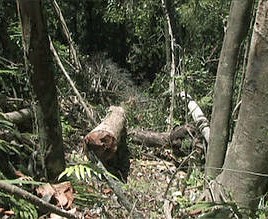
The slow-growing rosewood trees are found in relative isolation from each other. They are too dense to float very well, so loggers will fell several trees along river banks to make skids and rafts for bringing the logs to market.
Once the logs are floated and trucked to Malagasy ports, they are loaded onto container ships and hauled to China to make highly prized furniture and musical instruments. There are an estimated 10,000 to 15,000 metric tonnes of felled rosewood trees awaiting shipment from Madagascar's ports.
The Malagasy logger who fells the tree is paid about 50 US cents for "backbreaking work," Ms Barrett said. A Chinese rosewood armoire retails for about US$ 20,000.
"Enforcement of the Malagasy government's on-again, off-again policy against rosewood logging is pretty much nonexistent," Ms Barrett said. "Logging interests have threatened the safety of villages and at least one park office has been burned down," she added.
"If you protect the trees, you are also protecting habitat," Ms Barrett concludes. Seventy percent of Madagascar's species live in these forests and a large percentage of these are endemic to the Great Island.
afrol News - It is called "financial inclusion", and it is a key government policy in Rwanda. The goal is that, by 2020, 90 percent of the population is to have and actively use bank accounts. And in only four years, financial inclusion has doubled in Rwanda.
afrol News - The UN's humanitarian agencies now warn about a devastating famine in Sudan and especially in South Sudan, where the situation is said to be "imploding". Relief officials are appealing to donors to urgently fund life-saving activities in the two countries.
afrol News - Fear is spreading all over West Africa after the health ministry in Guinea confirmed the first Ebola outbreak in this part of Africa. According to official numbers, at least 86 are infected and 59 are dead as a result of this very contagious disease.
afrol News - It is already a crime being homosexual in Ethiopia, but parliament is now making sure the anti-gay laws will be applied in practical life. No pardoning of gays will be allowed in future, but activist fear this only is a signal of further repression being prepared.
afrol News / Africa Renewal - Ethiopia's ambitious plan to build a US$ 4.2 billion dam in the Benishangul-Gumuz region, 40 km from its border with Sudan, is expected to provide 6,000 megawatts of electricity, enough for its population plus some excess it can sell to neighbouring countries.










 front page
| news
| countries
| archive
| currencies
| news alerts login
| about afrol News
| contact
| advertise
| español
front page
| news
| countries
| archive
| currencies
| news alerts login
| about afrol News
| contact
| advertise
| español