See also:
» 08.02.2011 - Doing business in Africa "becoming easier"
» 11.11.2010 - African competition regulators getting serious
» 18.05.2010 - Economic diversification key to Africa's development
» 23.04.2010 - World Bank funding targets Africa’s malaria fight
» 12.04.2010 - Africa's research output dominated by three nations
» 31.03.2010 - "African growth more important than stability"
» 29.03.2010 - Illicit financial flows "ruining African development"
» 26.03.2010 - Aid tied to service delivery still best, WB


Africa | East Africa
Economy - Development | Science - Education | Society

East Africa a new population heavyweight

Large new generations put a strain on the African education system

© UNFPA Bénin/afrol News
afrol News, 20 October
- The East African region is slowly developing into one of the world's new population blocks, with the region surpassing all of North America in few years and all of Europe by the 2040s. A new, major power may be building up.

New data by the UN population fund UNFPA presented in London today reveal a major global population shift, where the Eastern African region is emerging as one of the world's largest blocks in the coming decades.

UNFPA data show that Eastern Africa already in 2010 has a total population of 327 million, thus having advanced into the most populated region in Africa. Recent growth has made smaller East Africa surpassing West Africa (306 million).

Together with the more sparsely populated Central African region, East Africa still has the world's highest population growth, thus securing that the region will keep on surpassing other regions. Both in Eastern and Central Africa, the average population growth is estimated at 2.6 percent annually.

In its projection, UNFPA therefore estimates the East African population to have more than doubled by 2050, then reaching a total of 711 million.

This fast growth would mean a dramatic shift of population centres globally. East Africa in a few years will have a larger population that all of North America. The slow growth in North America foresees that this vast continent will have a population of 448 million in 2050.

Also the Arab states' total population will be surpassed by the East African region during the next decade, despite relative high population growth numbers in the Arab world.

Even all of Europe will have a smaller population than the relatively small region of East Africa in 2050, as the European population is projected to decrease in the coming years. Europe's population in 2050 is projected to reach 691 million, compared to East Africa's 711 million.

And during the 2050s, East Africa could even surpass the entire population of Latin America and the Caribbean, from Mexico in the north to Argentina in the south.

In the 2050s, this will leave Eastern Africa as the world's third largest population block - and market - world-wide, after Southern Asia (mainly India) and Eastern Asia (mainly China).

In Africa, which is estimated to reach a total population of 2 billion in 2050, East Africa (711 million) and Western Africa (626 million) are crystallising as the two population heavyweights on the continent, UNFPA data show.

Central Africa by 2050 will, for the first time in its history, become a major population block (273 million) with a relatively dense population and therefore greater possibilities of growing a proper market. North Africa, and esp

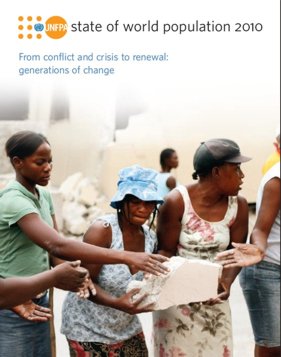
UNFPA's report "State of the world population 2010"

© Facsimile (afrol News)
ecially Southern Africa, are quickly loosing their proportional weight on the continent.

The UNFPA data also show that there is a major population shift between African states. Nigeria is today (158 million) Africa's most populated country, and will remain so in 2050 (289 million). Ethiopia however will take over the second place from Egypt within one or two years and reaches a population of 174 million by 2050, according to UNFPA estimates.

Congo Kinshasa (DRC) will make a leap on the list during the next decades. The vast and sparsely populated country now has a population of 68 million, which is projected to grow to 148 million by 2050, making the DRC the third most populated country in Africa.

The strongest population growth, world-wide, is however projected for Niger, currently at an annual rate of 3.9 percent. The impoverished and drought-prone Sahelian country is estimated to see its population increase from the current 16 million to 58 million in 2050, probably creating massive environmental and social problems.

The most massive population shift, however, is encountered in the East Africa region, with the block growing in population importance at large. Uganda will see the strongest growth - currently 3.3 percent annually - and will surpass Kenya's population in the 2030s and reach 91 million in 2050. Tanzania will get Africa's fifth largest population, totalling 110 million, by 2050, according to UNFPA data.

For East Africa, the massive projected population growth will mean both challenges and opportunities. With the establishment of a common market through the East African Community (EAC), the block may develop into a major world player during the next decades if the region's fast economic growth is maintained. A block of 711 million consumers in 2050 can not be ignored - if the population majority is lifted out of poverty.

But the enormous growth will also make social development difficult. Economic growth rates of at least 2.6 percent each and every year will be necessary only to maintain status quo. Only the additional growth can be used to reduce poverty. Food security in the region will depend on a "green revolution" or ever-increasing food imports, and the pressure on the environment will be immense.

Current trends however indicate that East Africa is able to combine a rapidly growing population with economic growth and poverty reduction. An optimistic view is therefore possible.


- Create an e-mail alert for Africa news
- Create an e-mail alert for East Africa news
- Create an e-mail alert for Economy - Development news
- Create an e-mail alert for Science - Education news
- Create an e-mail alert for Society news


    Printable version

On the Afrol News front page now


UN will not monitor human rights in Western Sahara

afrol News - The US has backed down on its demand that UN peacekeepers in Moroccan-occupied Western Sahara also shall monitor the human rights situation after Moroccan sources threatened to scale down relations with Washington.
Central African Republic
Central African Republic falling apart

afrol News - One month after the rebel movement Séléka took over power in the Central African Republic, unrest is spreading in the country. The new leader lacks control of his forces, which continue looting and abusing civilians.
Kenya
Kenyatta secures tight victory in Kenya

afrol News - The official election results in Kenya have finally been announced, and Uhuru Kenyatta managed to win the first poll round outright with a narrow 50.7 percent. But the main opponent, PM Raila Odinga, is filing a vote rigging complaint to the courts.
Cape Verde
Cape Verde to produce dragon fruit

afrol News - Cape Verde authorities have invested large sums to diversify the arid country's agricultural sector. Now, the dragon fruit, originating in tropical America, is being introduced for the first commercial production in Africa.
Egypt
Even governors in Pharaonic Egypt died in their 20s

afrol News - Researchers have analysed more than 200 mummies from ancient Egypt, finding that even high dignitaries were poorly nourished and had infectious diseases. The typical governor in Pharaonic Egypt died before he was 30 years old.


front page | news | countries | archive | currencies | news alerts login | about afrol News | contact | advertise | español 

©  afrol News. Reproducing or buying afrol News' articles.

   You can contact us at mail@afrol.com