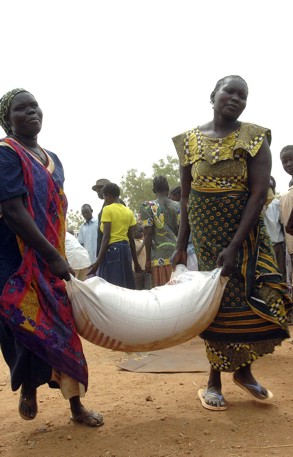
afrol News, 21 October - Ahead of the independence referendum in South Sudan, 1.5 million South Sudanese are "repatriated" from the north to the south to be able to vote. If they can ever return remains uncertain.
South Sudan will probably emerge as Africa's newest state after the January 2011 referendum, and is further likely to become the continent's new poorest nation. Despite this, the autonomous South Sudanese government is shying no costs to increase its population even more before January.
Only the operation to recruit and physically move the estimated 1.5 million South Sudanese living in the north comes at an estimated cost of US$ 25 million. The southern government, in its capital Juba, this month approved of an immediate repatriation budget of US$ 12.5 million, hoping to raise the other half of the costs from donors.
Costs on the massive project are already running. On 12 October, a South Sudanese government delegation visited Khartoum to oversee the progress of registration and repatriation, which at that moment had just started.
Southern representatives have launched a campaign in Khartoum and other northern cities to urge southerners living in the north "to return to ensure a large turn-out and registration to vote in the January referendum on possible separation of the South from Sudan," according to the Norwegian Refugee Council (NRC).
The Juba government hopes to recruit up to 1.5 million new citizens ahead of the poll. The repatriation campaign even is to target South Sudanese living in Egypt, according to the NRC.
No arrangements are made for the possible return of these South Sudanese after the vote. The Juba government is confident of winning the poll and foresees that southerners will find it difficult to stay in the north after a split into two states.
The repatriated South Sudanese are therefore expected to stay and help construct the new country.
Human rights monitors and humanitarian agencies have already expressed concern over the feasibility of the plan as Southern Sudan is extremely poor, underdeveloped and unable to ensure adequate living conditions for its citizens, let alone the newcomers.
The NRC holds that the repatriation budget of US$ 25 million is far too low to cover the real costs of the massive project. "Significantly more funding will be required to make the return of internally displaced persons sustainable," the organisation warns. There are no funds for building houses, schools and basic infrastructure for the newcomers.
"The planned mass return would create enormous pressure on struggling and impoverished communities in Southern Sudan. Any plans for repatriation or return should be conditional on realistic preparations for reintegration being in place," according to an NRC analysis.
But even the transport costs for the repatriating South Sudanese could easily blow government's modest repatriating budget. No coordinated transport plan has been made, and returnees were expected to "use all forms of transportation: by planes, by vehicles, by train and by steamers and so on," according to a Juba government official.
What expects them in Juba, is the referendum. Further plans for their re-integration to South Sudan have not been made.
"People should not be moved, to be used as a political tool during the referendum," Joel Charny of Refugees International comments on the ongoing mass repatriation exercise.
afrol News - It is called "financial inclusion", and it is a key government policy in Rwanda. The goal is that, by 2020, 90 percent of the population is to have and actively use bank accounts. And in only four years, financial inclusion has doubled in Rwanda.
afrol News - The UN's humanitarian agencies now warn about a devastating famine in Sudan and especially in South Sudan, where the situation is said to be "imploding". Relief officials are appealing to donors to urgently fund life-saving activities in the two countries.
afrol News - Fear is spreading all over West Africa after the health ministry in Guinea confirmed the first Ebola outbreak in this part of Africa. According to official numbers, at least 86 are infected and 59 are dead as a result of this very contagious disease.
afrol News - It is already a crime being homosexual in Ethiopia, but parliament is now making sure the anti-gay laws will be applied in practical life. No pardoning of gays will be allowed in future, but activist fear this only is a signal of further repression being prepared.
afrol News / Africa Renewal - Ethiopia's ambitious plan to build a US$ 4.2 billion dam in the Benishangul-Gumuz region, 40 km from its border with Sudan, is expected to provide 6,000 megawatts of electricity, enough for its population plus some excess it can sell to neighbouring countries.










 front page
| news
| countries
| archive
| currencies
| news alerts login
| about afrol News
| contact
| advertise
| español
front page
| news
| countries
| archive
| currencies
| news alerts login
| about afrol News
| contact
| advertise
| español