See also:
» 21.10.2010 - Kenyan pupils find teachers in laptops
» 11.10.2010 - Most Kenyans say no to cleaner energy
» 09.03.2010 - Kenya farmers get low-tech micro-insurance
» 09.12.2009 - Kenya goes digital
» 27.10.2009 - Kenya leads Africa rural connect in third round
» 17.09.2008 - Telkom Kenya joins stiff mobile phone market
» 16.11.2007 - Kenya to increase milk production
» 15.05.2007 - Kenya hosts pan-African ICT conference


Kenya
Technology | Agriculture - Nutrition | Health

E-payment for a cup of water in Kenya

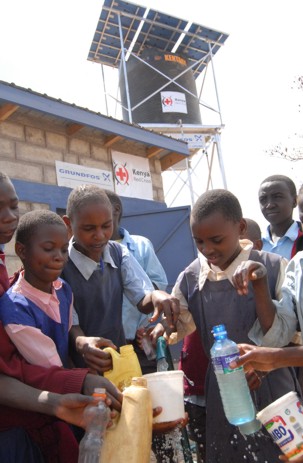
A solar pump provides water for locals in Kenya's Kambi ya Juu village

© Grundfos/afrol News
afrol News, 22 October
- In a rural district grossly neglected by Kenyan authorities, private actors have introduced groundbreaking technology to provide basic services. E-payment, microfinance and solar energy secure safe water for villagers.

Water supply to the village Kambi ya Juu, outside Isiolo in central Kenya 285 kilometres north of Nairobi, ended ten years ago. City authorities in Isiolo, faced with a strongly growing urban population, chose to use the scarce water resources within Isiolo and simply cut off the water to smaller villages surrounding the city.

The Kenyan government, district or city authorities had no plans to secure clean water to the outlying villages, despite the existence of distribution channels. Villagers were left to fetch their water in the bush, hours of walking away.

"The water isn't clean. The people who live up the hill wash both themselves and their clothes in the brook. If we are not careful to boil the water, we will get sick," says Ann Akopi from Kambi ya Juu.

In this arid part of Kenya, lack of access to clean water and the traditional rivalry between pastoral and agricultural ethnicities led to deadly clashes only last year, with 20 dead and least 1,700 families displaced in villages near Isiolo town, including Kambi ya Juu. "Tensions over water and pasture during a drought" led to the rioting, according to UN sources.

The Kenyan Red Cross Society (KRCS) provided first-aid services to the victims of the clashes, but foresaw that the deep-rooted government neglect of this rural arid region could lead to even worse conflicts at any time. The KRCS therefore asked its international partners for help to remove the root causes of the conflict.

They found a partner in their Danish sister organisation, which in turn was working with the Danish company Grundfos, a world leading producer of water pumps, which had presented its "Lifelink system" to the Danish Red Cross (DRK). The Lifelink system mainly consists of a water pump driven by solar energy.

The idea of how to provide cheap water over a long-term period actually was conceived by workers at Grundfos, who also agreed to finance parts of the project out of their own pockets.

Starting in Kambi ya Juu, the project consists of installing the solar driven water pumps in the villages, combining them with payment systems over the mobile phone network using microfinance systems. When the villagers need water, "they pay for it via their mobile phones. They only pay for the water they use," according to Grundfos.

The solar well in Kambi ya Juu will be inaugurated next week, as the first of ten in the Isiolo district. The first pump is to provide around 3,000 people with safe water, while the entire project targets

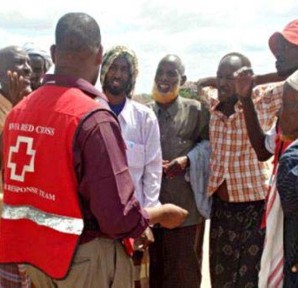
During the 2009 drought, the Kenyan Red Cross assisted rural communities

© KRC/afrol News
up to 16,000 people.

Due to long-term drifting costs, a totally free provision of water to the villagers - who in some cases are totally deprived internally displaced persons - was never considered. afrol News tried to raise the ethical debate around charging money for basic services from impoverished societies with DRK spokesman Hans Beck Gregersen, but he declined to comment.

But the price of water is kept as low as possible. "The price for 20 litres of clean water is 2 shilling - or less than euro 0.02," Frank Winther told afrol News. This is competitive, compared to public and private water utilities in Kenya.

"The price only covers the actual running costs," assures Mr Winther. The running costs mainly include maintenance and the works of a local water committee running each pump system.

In each village, the local community appoints a water committee among future users, which is given training to take over the responsibility of drifting and maintaining the water system. The committee also is to teach villagers "to change behaviour regarding hygienic standards," according to Carsten Mahnfeldt from the DRK.

The water committee may look forward to sustainable revenue levels to finance its works and the well's maintenance. "By experience we know that 2,500 inhabitants use approximately 10,000 litres per day or 4 litre per person per day," says Mr Winther. That should produce annual revenues of around KSh 365,000 (euro 3,250) in Kambi ya Juu.

The Grundfos spokesman assures afrol News there are no hidden costs for villagers or hidden revenues for the Danish company. "The installation of for example pump, solar-panel and the building of the unit on-site is donated by workers from Grundfos," he says. He adds that, "to our knowledge," there are also no major costs by using the mobile phone payment application for villagers.

Barasa Mabonga, a representative from the Kenyan Red Cross, says the solution more than lives up to the expectations they had when looking for a viable solution to the water crisis in the Isiolo district. "It is no doubt the best system, I have ever seen," Mr Mabonga comments ahead of Tuesday's inauguration ceremony in Kambi ya Juu.

Also the Danish Red Cross is satisfied with the project, and has committed to assist the installation of the system in "at least" nine more Kenyan localities by 2012. "Thereafter, possible next steps regarding implementation of further water projects in new regions will be decided," the DRK announced today.


- Create an e-mail alert for Kenya news
- Create an e-mail alert for Technology news
- Create an e-mail alert for Agriculture - Nutrition news
- Create an e-mail alert for Health news


    Printable version

On the Afrol News front page now


UN will not monitor human rights in Western Sahara

afrol News - The US has backed down on its demand that UN peacekeepers in Moroccan-occupied Western Sahara also shall monitor the human rights situation after Moroccan sources threatened to scale down relations with Washington.
Central African Republic
Central African Republic falling apart

afrol News - One month after the rebel movement Séléka took over power in the Central African Republic, unrest is spreading in the country. The new leader lacks control of his forces, which continue looting and abusing civilians.
Kenya
Kenyatta secures tight victory in Kenya

afrol News - The official election results in Kenya have finally been announced, and Uhuru Kenyatta managed to win the first poll round outright with a narrow 50.7 percent. But the main opponent, PM Raila Odinga, is filing a vote rigging complaint to the courts.
Cape Verde
Cape Verde to produce dragon fruit

afrol News - Cape Verde authorities have invested large sums to diversify the arid country's agricultural sector. Now, the dragon fruit, originating in tropical America, is being introduced for the first commercial production in Africa.
Egypt
Even governors in Pharaonic Egypt died in their 20s

afrol News - Researchers have analysed more than 200 mummies from ancient Egypt, finding that even high dignitaries were poorly nourished and had infectious diseases. The typical governor in Pharaonic Egypt died before he was 30 years old.


front page | news | countries | archive | currencies | news alerts login | about afrol News | contact | advertise | español 

©  afrol News. Reproducing or buying afrol News' articles.

   You can contact us at mail@afrol.com