


|
Kenya Agriculture - Nutrition | Technology | Economy - Development Kenya farmers get low-tech micro-insurance
As East Africa recovers from the worst drought in decades, an innovative program launched this week is using a low-cost, mobile phone payment and data system, and automated, solar powered weather stations, to offer thousands of farmers in parts of West and Central Kenya affordable, "pay as you plant" insurance to protect their investments in desperately needed high-yielding seeds, fertilizers, as well as other farm inputs.
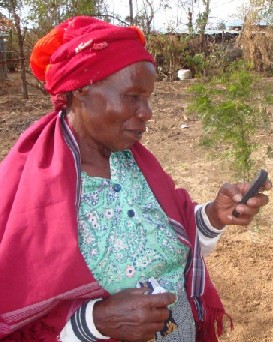
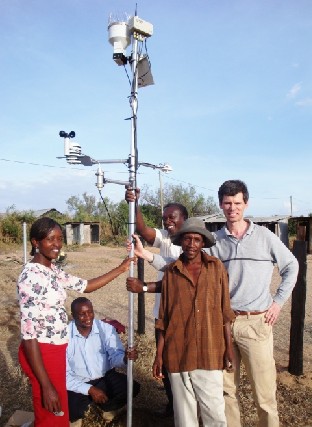
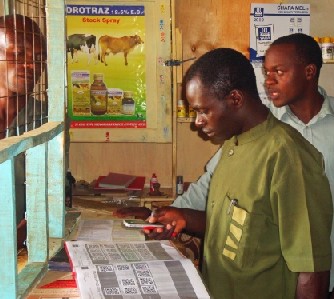
Agro-dealers have been equipped with a camera phone that scans a special bar code at the time of purchase, which immediately registers the policy with UAP Insurance over the Safaricom's mobile data network. This mobile phone application then sends a text (SMS) message confirming the insurance policy to the farmer's mobile phone. Some 30 weather stations in the targeted regions have been renovated with automated, solar-powered systems capable of broadcasting regular updates on weather conditions and rainfall quantities. When data transmitted over Safaricom's 3G data network from a particular station indicates that drought or other extreme conditions - including excessive rains - are destined to cripple crops, all farmers registered with that station automatically receive payouts directly via Safaricom's M-PESA mobile money transfer service. "This is the first project to use mobile phones to set up insurance contracts and issue payouts to poor, smallholder farmers in Africa," said Betty Mwangi at Safaricom. "The close link to rural shops and farmers insures that thousands of farmers will have fast, efficient, and reliable service and shows that there is great potential for many other applications that link mobile technology with the needs of farmers and people in rural areas." The project was pilot-tested in 2009 in the Laikipia district in Kenya's Rift Valley Province, where 200 farmers purchased insurance for seeds and herbicides, and, after the drought, received compensation for 80 percent of their investment. As the larger programme gets underway, the Syngenta Foundation and UAP expect to reach up to 5,000 farmers in 2010. The plan is to then expand into Eastern Kenya in 2011 and to all key farming areas of the country by 2012, with the goal of eventually offering the insurance to as many as 50,000 Kenyan farmers. Crop insurance is considered essential to agriculture in developed countries but has been largely unavailable to farmers in low-income countries, in part because of the costs of administering "micro" policies. Conventional crop insurance requires field inspections at the time the policy is issued, and follow-up visits to confirm damage. Such procedures can be cost-effective for large farms, but are far too expensive to be
Also, while microfinance has taken off in many poor countries, micro-insurance, particularly for agriculture, has largely failed to take off because it offered no immediate benefit to farmers. As a result, farmers showed little interest. Further, farmers' lack of trust in proposed insurance schemes has posed a significant barrier, according to Mr Wambugu. Previous experiments in micro-insurance for smallholder farmers have relied on subsidies or funding from international aid institutions, leading to questions about their ability to be scaled-up and sustained over the long term. The Kilimo Salama initiative seeks to overcome these obstacles by employing a variety of innovations. First, payouts are triggered by a relatively inexpensive index system tied to local weather conditions. The weather stations, which are generally located at schools, private farms or other secure locations, allow experts to determine when the situation in a particular area has deteriorated to the point that crops are no longer viable. Costs are further reduced by using the Safaricom data network to record policies and transfer funds, both the premiums to UAP and the payouts to farmers. The cost of each transaction is minimal - far less than the price of a SMS message. In addition, the system is designed to build trust by allowing farmers to purchase policies for relatively little cash out-of-pocket and on a "pay as you plant" basis. And by partnering with agricultural companies that sponsor premiums, organisers have been able to avoid dependence on government subsidies. "Also, payouts go directly to farmers, not to a middleman or a loan provider," added Mr Ferroni. Officials at UAP and Syngenta say evidence from the pilot programme makes them optimistic that the program can be widely successful. Already, in the Nanyuki area, where Kilimo Salama was first developed, the average amount of seed insured has risen from 2 kilograms per farmer to 4 kilograms. Also, while initially farmers were mainly purchasing insurance only for seeds, they are now purchasing it for fertilizer, as well - for an average of 50 kilograms of fertilizer per farmer. "When it comes to drought, most farmers have no choice but to simply pray for rain. And if the rains don't come, the crops don't grow. At a time of global change, we are trying to give farmers more options so they can meet these challenges and prosper," said Mr Wambugu. By staff writer © afrol News - Create an e-mail alert for Kenya news - Create an e-mail alert for Agriculture - Nutrition news - Create an e-mail alert for Technology news - Create an e-mail alert for Economy - Development news
On the Afrol News front page now
|







 front page
| news
| countries
| archive
| currencies
| news alerts login
| about afrol News
| contact
| advertise
| español
front page
| news
| countries
| archive
| currencies
| news alerts login
| about afrol News
| contact
| advertise
| español
©
afrol News.
Reproducing or buying afrol News' articles.
You can contact us at mail@afrol.com