See also:
» 06.04.2010 - Is computer learning becoming redundant in Africa?
» 16.02.2010 - Mobile phone connections to exceed 5 billion
» 09.11.2009 - African mobile market continues to develop at a rapid rate
» 23.10.2009 - ITU approves new universal mobile phone charger
» 06.10.2009 - Africa still lagging behind in ICTs
» 06.10.2009 - Gateway boosts its pan-Africa network strength
» 01.10.2009 - MTN signs major deal with IMImobile
» 04.09.2009 - New cables to kick-start Africa's new broadband era, report


Africa
Economy - Development | Technology

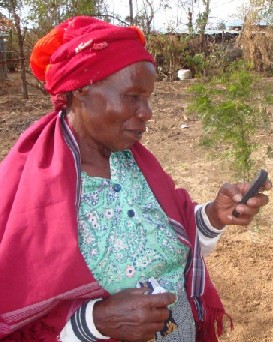
Every 2nd African has mobile subscription

Mobile phones are also reaching rural areas of Africa, including farmers in Kenya

© afrol News/Chris Pearson
afrol News, 17 November
- Africa this year crossed the 500 million active mobile subscriptions mark. By now, every second person of Africa's 1,033 million inhabitants can be reached by phone, making Africa a sizable market.

These numbers were presented by Thecla Mbongue, a Johannesburg-based senior analyst at Informa Telecoms & Media. According to the latest data available to Ms Mbongue, the number of active mobile subscriptions in Africa reached 506 million at end-September 2010.

Africa now accounts for 10 percent of the world's mobile subscriptions and remains one of the world's fastest-growing regions - with the subscription numbers increasing 18 percent over the year to September, accord to Ms Mbongue.

This continues fast growth was a result of "the still low mobile penetration rate on the continent as well as demand for new services, such as mobile Internet access, that increase the need for telecoms connectivity."

Although the rate of growth in mobile subscriptions in Africa now would slow as markets mature, "the continent continues to offer great opportunities for investors in the voice segment in under-penetrated markets and also in the non-voice segments with mobile broadband and mobile-money services taking off," according to the analyst.

"By 2015, there will be 265 million mobile broadband subscriptions in Africa, a huge increase from the current figure of about 12 million, and accounting for 31.5 percent of the total of 842 million mobile subscriptions that the continent will have in five years' time," according to forecasts by Informa. "There will be almost 360 million users of mobile-money services on the continent by 2014," Ms Mbongue adds.

The mobile revolution that has swept through Africa had made mobile telephony widely available, "but there are still substantial under-served markets - in rural areas the rate of mobile penetration is typically below 10 percent, for example," she adds, pointing out that these were still markets to conquer for investors.

The l

Africa telecom market analyst Thecla Mbongue

© Informa/afrol News
anding of a series of new submarine cables on both the East and West coasts of Africa over the past 18 months had given the continent a good level of international connectivity for the first time, and had greatly expanded the opportunities for data services.

However, terrestrial backhaul threatened to become the next bottle-neck, Ms Mbongue warned, and this "must be extended if the benefits of the new connectivity are to be made widely available and in particular reach rural communities and countries in the interior of the continent," she advised.

The next big market is the provision of Internet services in Africa. The rate of household broadband penetration in Africa was just 2.5 percent in the beginning of 2010, "so African broadband has a long way to go if it is to emulate the mobile revolution that has already swept through much of the continent," Ms Mbongue holds.

According to data analysed by Informa, Nigeria, Africa's most populous country, is also its largest mobile market, accounting for 16 percent of the continent's mobile subscriptions.

Egypt and South Africa are the second and third largest mobile markets on the continent. Nigeria, Egypt, Morocco, Tanzania and Zimbabwe together accounted for 48 percent of the 54 million net additions to Africa's mobile subscription market over the nine months to September.

Over the coming five years, Informa expects the strongest growth rates in mobile subscriptions to be recorded mainly in East and Central African markets, with Ethiopia, Congo Kinshasa (DRC), Eritrea and Madagascar forecast to see mobile subscription numbers increase by more than 100 percent by 2015.

Africa's first mobile network was launched in Tunisia in 1985, so 2010 marks the twenty-fifth anniversary of mobile telephony on the continent.


- Create an e-mail alert for Africa news
- Create an e-mail alert for Economy - Development news
- Create an e-mail alert for Technology news


    Printable version

On the Afrol News front page now


UN will not monitor human rights in Western Sahara

afrol News - The US has backed down on its demand that UN peacekeepers in Moroccan-occupied Western Sahara also shall monitor the human rights situation after Moroccan sources threatened to scale down relations with Washington.
Central African Republic
Central African Republic falling apart

afrol News - One month after the rebel movement Séléka took over power in the Central African Republic, unrest is spreading in the country. The new leader lacks control of his forces, which continue looting and abusing civilians.
Kenya
Kenyatta secures tight victory in Kenya

afrol News - The official election results in Kenya have finally been announced, and Uhuru Kenyatta managed to win the first poll round outright with a narrow 50.7 percent. But the main opponent, PM Raila Odinga, is filing a vote rigging complaint to the courts.
Cape Verde
Cape Verde to produce dragon fruit

afrol News - Cape Verde authorities have invested large sums to diversify the arid country's agricultural sector. Now, the dragon fruit, originating in tropical America, is being introduced for the first commercial production in Africa.
Egypt
Even governors in Pharaonic Egypt died in their 20s

afrol News - Researchers have analysed more than 200 mummies from ancient Egypt, finding that even high dignitaries were poorly nourished and had infectious diseases. The typical governor in Pharaonic Egypt died before he was 30 years old.


front page | news | countries | archive | currencies | news alerts login | about afrol News | contact | advertise | español 

©  afrol News. Reproducing or buying afrol News' articles.

   You can contact us at mail@afrol.com