See also:
» 26.02.2013 - Mass protests shake Djibouti
» 25.02.2013 - Djibouti vote rigging may cause new mass protests
» 11.03.2011 - Djibouti opposition boycotts election
» 04.03.2011 - Djibouti protests stopped by police
» 27.02.2011 - Mass arrests stopped further Djibouti protests
» 20.02.2011 - Djibouti opposition leaders freed
» 18.02.2011 - Djibouti protests more massive than expected
» 17.02.2011 - Mobilisation for Djibouti protests worldwide


Djibouti
Politics | Human rights

Djibouti protesters keep up the pressure

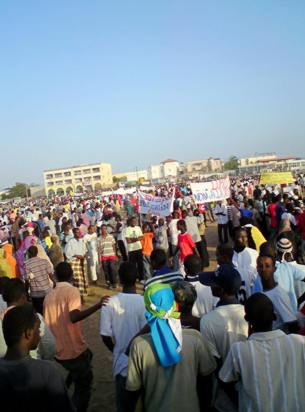
An estimated 25,000 Djiboutians protested against government on 18 February

© ARD-Djibouti/afrol News
afrol News, 19 February
- Protesters in Djibouti keep taking to the streets today, after a mass protest on Friday gathered more people than expected. At least two have been killed in clashes so far and the opposition leader is arrested.

Yesterday's mass protests gathered between 20,000 and 30,000 people in central Djibouti City after the Friday prayers, according to opposition sources and photos documenting the mass event. The protesters flocked behind the main opposition, the Union for a Democratic Alternative (UAD), demanding President Ismaďl Omar Guelleh to step down.

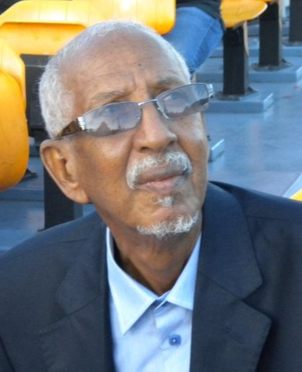
UAD President Ismaël Guedi Hared earlier had expected far less people to participate in the anti-government protests. Djiboutians are enraged by President Guelleh's unconstitutional third term bid in the upcoming April elections.

As new protests started earlier today, the Djibouti government today for the first time has commented on the protest movement. Earlier, government had declined any comments to the press, including afrol News.

Today, Interior Minister Yacin Elmi Bouh agreed to talk to the UK agency 'Reuters'. He strongly downplayed yesterday's protests, claiming only a few "hundreds of demonstrators" had demanded President Guelleh's resignation, adding that the rioting was only taking place in a city suburb called Balbala.

Djibouti opposition and human rights groups - which all have joined the protests - however have presented photo documentation o

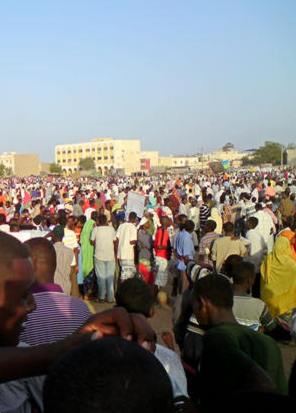
Djibouti protesters re-baptised "Independence Square" to "Freedom Square"

© ARD-Djibouti/afrol News
f tens of thousands of protesters dominating central Djibouti City yesterday, with the marches starting in Abdl Nasr Avenue and moving close to the presidential palace.

"The crowd exceeded the capacity of Nasr Avenue, and moved like a giant worm towards the big Hassan Gouled stadium and Independence Square, now renamed Freedom Square," the opposition group ARD-Djibouti reported from the capital, estimating "the initial crowd" around noon at 20,000 protesters.

"Despite an impressive police presence throughout the capital, blocking all major roads in the city, activists and supporters flocked to the centre from all sides," the opposition group adds. It estimates that about 60,000 people were protesting in central Djibouti at 3 PM, when the manifestation reached its heights.

Opposition groups agree that the massive protests were peaceful during day. But as darkness fell, the first reports of gunshots came from Djibouti City. At around 6 PM "police began attacking protesters camping in the centre, resulting in at least 24 persons being wounded," ARD-Djibouti reports.

Police wanted to hinder protesters from establishing a Tahrir-like camp at "Freedom Square", dispersing the crowds with teargas a

Ismaël Guedi Hared, President of Djibouti's UAD opposition alliance

© UAD/afrol News
nd rubber bullets. Clashes thereafter spread to other Djibouti City neighbourhoods, with cars being put on fire and police starting to use sharp ammunition.

According to opposition sources, one protester was killed and two protesters were "seriously injured" following the use of sharp ammunition. Interior Minister Bouh, on the other hand, claims that "at least" one police officer was killed by protesters.

Yesterday, at least 20 protest leaders, including Mohamed Daoud Chehem, leader of the minor opposition Djibouti Development Party (PDD), were arrested. Today, the arrests continue, with confirmed reports that UAD leader Hared - the country's main opposition leader - this afternoon was arrested in his home by police.

Despite the violent response by the Guelleh regime, protesters today again took to the streets, trying to reach "Freedom Square". The nucleus of protest is now the Balbala suburb, which was kept in protesters' hands during the night.

The rough response indeed seemed to cement anti-government sentiments in Djibouti and uniting all opposition groups. PDD spokesman Hamadou Ali Ben Ali today issued a "promise" that the dictatorship would "be defeated" by further constant protests.


- Create an e-mail alert for Djibouti news
- Create an e-mail alert for Politics news
- Create an e-mail alert for Human rights news


    Printable version

On the Afrol News front page now


UN will not monitor human rights in Western Sahara

afrol News - The US has backed down on its demand that UN peacekeepers in Moroccan-occupied Western Sahara also shall monitor the human rights situation after Moroccan sources threatened to scale down relations with Washington.
Central African Republic
Central African Republic falling apart

afrol News - One month after the rebel movement Séléka took over power in the Central African Republic, unrest is spreading in the country. The new leader lacks control of his forces, which continue looting and abusing civilians.
Kenya
Kenyatta secures tight victory in Kenya

afrol News - The official election results in Kenya have finally been announced, and Uhuru Kenyatta managed to win the first poll round outright with a narrow 50.7 percent. But the main opponent, PM Raila Odinga, is filing a vote rigging complaint to the courts.
Cape Verde
Cape Verde to produce dragon fruit

afrol News - Cape Verde authorities have invested large sums to diversify the arid country's agricultural sector. Now, the dragon fruit, originating in tropical America, is being introduced for the first commercial production in Africa.
Egypt
Even governors in Pharaonic Egypt died in their 20s

afrol News - Researchers have analysed more than 200 mummies from ancient Egypt, finding that even high dignitaries were poorly nourished and had infectious diseases. The typical governor in Pharaonic Egypt died before he was 30 years old.


front page | news | countries | archive | currencies | news alerts login | about afrol News | contact | advertise | español 

©  afrol News. Reproducing or buying afrol News' articles.

   You can contact us at mail@afrol.com