See also:
» 26.02.2013 - Mass protests shake Djibouti
» 25.02.2013 - Djibouti vote rigging may cause new mass protests
» 04.03.2011 - Djibouti protests stopped by police
» 27.02.2011 - Mass arrests stopped further Djibouti protests
» 20.02.2011 - Djibouti opposition leaders freed
» 19.02.2011 - Djibouti protesters keep up the pressure
» 18.02.2011 - Djibouti protests more massive than expected
» 17.02.2011 - Mobilisation for Djibouti protests worldwide


Djibouti
Politics | Human rights

Djibouti opposition boycotts election

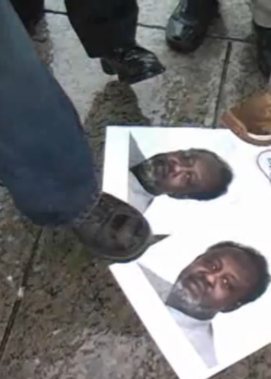
Djiboutians worldwide keep protesting against President Guelleh: Here in Ottawa on 5 March

© "Kaydka"/YouTube/afrol News
afrol News, 11 March
- As the deadline to register candidates for Djibouti's 8 April presidential election has passed, no opposition candidates have registered. The boycott comes as further anti-government protests are planned.

Djiboutian opposition leaders had until 8 March to put forward a candidate for the upcoming controversial elections. But according to government sources, not a single person has submitted their name to the Ministry of Interior.

Sources confirmed that there will be only two names on the ballot paper: the incumbent President Ismaël Omar Guelleh and Mohammed Warsama, the former President of the Constitutional Court and an ally of President Guelleh.

Mr Warsama is widely believed to have presented his candidacy to shed a light of legitimacy over the 8 April elections, as the united opposition had also boycotted the 2005 and 2008 elections following a failure to reform the electoral code and to assure free and fair polls.

Djibouti's main opposition coalition, the Union for a Democratic Alternative (UAD), has strongly protested last year's constitutional amendment, which allowed President Guelleh to seek a third term in office. Since February, the UAD together with other opposition parties and civil society groups has organised mass protests against the Guelleh regime, protesting the third term and urging him to step down.

UAD President Ismaël Guedi Hared, who has been a leading figure of the mass protests, also led the election boycott calls and has not re

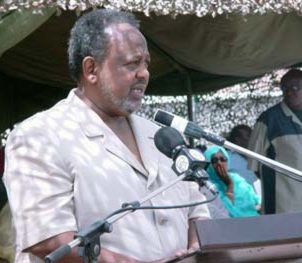
Djiboutian President Ismaïl Omar Guelleh

© WHO/afrol News
gistered his candidacy to the presidency. Other Djiboutian opposition parties have followed the boycott call, demanding changes to the electoral code and the withdrawal of President Guelleh's candidacy.

Today, also Abdourahman Boreh - a prominent exiled Djibouti businessman who had announced his desire to stand candidate in the April election - announced that he had withdrawn his candidacy before the 8 March deadline. He said that he "had been given no indication that the elections were going to be free and fair."

Mr Boreh said that he also "feared that his supporters would face intimidation, and possibly violence, at the ballot box given the recent demonstrations in Djibouti which saw police fire live bullets and tear gas at anti-government protestors."

"I decided that the election was not going to be free and fair. If I, or any other opposition candidate had stood, we would have only been adding to the perceived legitimacy of the election - a legitimacy that it does not deserve," Mr Boreh said in a statement forwarded to afrol News.

As a united opposition has implemented its election boycott, new anti-government protests are now planned.

On 8 February, an estimated 30,000 anti-government protestors took to the streets of Djibouti City to call for

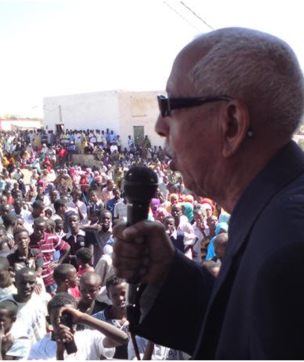
Ismaël Guedi Hared, President of Djibouti's UAD opposition alliance, at a 22 January rally

© UAD/afrol News
President Guelleh to step down. Another demonstration had been planned for 4 March, but opposition groups were forced to call if off after armed police and soldiers came out in force to confront the protestors.

But the protest movement as lived on. On Tuesday, the first major demonstrations outside Djibouti City were held in the northern towns of Tadjourah, Obock and Balho. Here, thousands peacefully took to the streets shouting "No to the third term!" and "Guelleh, step down!"

The UAD and four other Djiboutian opposition groups meanwhile informed the Ministry of the Interior that peaceful anti-government protests from now on would be held in central Djibouti City "each Friday from 14 to 18 hours."

The Ministry yesterday in a formal reply prohibited the demonstrations, pointing to a decree by French colonial authorities issued in 1937. Going forward with the protests - "aimed at overthrowing government" - would put the opposition in a "radically illegal position," according to the letter from the Ministry.

President Guelleh's People's Rally for Progress party has ruled Djibouti since independence from France in 1977. Mr Guelleh, first elected in 1999, amended the constitution in March 2010 to allow him to extend his rule by two more six-year terms.


- Create an e-mail alert for Djibouti news
- Create an e-mail alert for Politics news
- Create an e-mail alert for Human rights news


    Printable version

On the Afrol News front page now


UN will not monitor human rights in Western Sahara

afrol News - The US has backed down on its demand that UN peacekeepers in Moroccan-occupied Western Sahara also shall monitor the human rights situation after Moroccan sources threatened to scale down relations with Washington.
Central African Republic
Central African Republic falling apart

afrol News - One month after the rebel movement Séléka took over power in the Central African Republic, unrest is spreading in the country. The new leader lacks control of his forces, which continue looting and abusing civilians.
Kenya
Kenyatta secures tight victory in Kenya

afrol News - The official election results in Kenya have finally been announced, and Uhuru Kenyatta managed to win the first poll round outright with a narrow 50.7 percent. But the main opponent, PM Raila Odinga, is filing a vote rigging complaint to the courts.
Cape Verde
Cape Verde to produce dragon fruit

afrol News - Cape Verde authorities have invested large sums to diversify the arid country's agricultural sector. Now, the dragon fruit, originating in tropical America, is being introduced for the first commercial production in Africa.
Egypt
Even governors in Pharaonic Egypt died in their 20s

afrol News - Researchers have analysed more than 200 mummies from ancient Egypt, finding that even high dignitaries were poorly nourished and had infectious diseases. The typical governor in Pharaonic Egypt died before he was 30 years old.


front page | news | countries | archive | currencies | news alerts login | about afrol News | contact | advertise | español 

©  afrol News. Reproducing or buying afrol News' articles.

   You can contact us at mail@afrol.com