See also:
» 12.10.2010 - Africa sees successes fighting hunger
» 05.10.2010 - Scientists create African banana Wiki
» 27.09.2010 - Cowpea scientists promise to end African hunger
» 09.07.2010 - Researchers seek climate change-proof food crops
» 09.04.2010 - Can Africa feed herself...?
» 30.03.2010 - "Myths hinder potential of cassava in Africa"
» 10.03.2010 - Call for common African food market
» 09.03.2010 - "Subsidise infrastructure, not fertilisers," report


Agriculture, Africa
© Arne Hoel/World Bank/afrol News
Africa
Agriculture - Nutrition | Human rights

How African land deals override locals

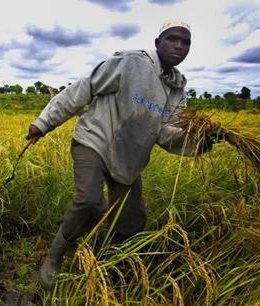
Rice cultivator in Bagré, Burkina Faso

© Alessandra Benedetti/FAO/afrol News
afrol News, 9 March
- A new study into current land lease and sale contracts in Africa shows how local land users are mostly not even consulted in the process. When consulted, they are often tricked.

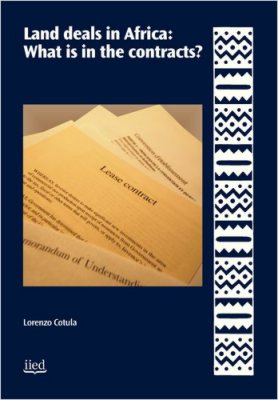
Over the past few years, agribusiness, investment funds and government agencies have been acquiring long-term rights over large areas of land in Africa. A new 56-page report from the International Institute for Environment and Development (IIED) looks at the contractual terms of 12 land deals all over Africa.

Land contracts are typically signed between two parties, mostly not including local land users. In most of the deals reviewed by IIED, land was allocated by a central government agency. While in many cases government responded to requests for land from outside investors, in others such as Mali it reportedly played a proactive role in seeking out investors.

"The central role of the state in land allocations reflects trends in national law," according to author Lorenzo Cotula. In most African countries, land is owned by the state. For instance, land is nationalised in Ethiopia, where private land ownership is outlawed and only long-term land leases may be acquired.

Countries such as Mali and Cameroon do allow private land ownership, which may be acquired through land registration procedures. "But even in these cases, costly and cumbersome procedures mean that very few rural people hold ownership rights," according to Mr Cotula.

Where customary tenure systems are perceived as legitimate, local resource users feel they have sufficient tenure security under these systems without needing to seek formal title. In Cameroon, for example, only about 3 percent of the land has been formally registered and is held under private ownership, mainly by urban elites such as politicians and businessmen.

"As in many jurisdictions all untitled land is owned by the state, governments end up controlling much rural land even where the statute books devote numerous provisions to regulating private ownership," according to the report.

Although the land is formally owned by the state, there are of course local people - farmers, herders, hunter-gatherers - that often used it for generations and see the land as theirs.

Mr Cotula warns that "there are widespread perceptions in government and investor circles that much land in Africa is empty or underutilised," based on statistical databases and satellite imagery. "But much of this data goes back to the mid-1990s and does not fully factor in intervening changes such as land degradation; and satellite-based studies seriously underestimate the land areas used by shifting c

IIED report on the African land grab

© IIED/afrol News
ultivation and pastoralism," he adds.

"In practice, very large land deals are bound to involve some squeeze on existing rights, even where the intensity of current resource use is low. This is particularly so where agricultural investments target higher-value lands," the IIED report says.

"The problem is that the customary rights of local people may have no or little recognition under national law. This circumstance is historically rooted in the colonial experience," Mr Cotula explains.

In countries like Cameroon and Ethiopia, where customary rights are not legally recognised, and even in countries like Mali, where customary land rights enjoy some protection, national law considers most rural people as having qualified use rights on state-owned land. As a result, the government has sole legal authority to sign off transactions.

Governments and investors may still undertake local consultations, "but in many publicly reported deals local people are not party to negotiations affecting their land, have little say in decision-making and are therefore vulnerable to dispossession," the study found.

Also, negotiations tend to happen behind closed doors and the contracts are rarely publicly available. "Lack of transparency and public scrutiny creates the breeding ground for corruption and deals that do not maximise the public interest," Mr Cotula warns. Liberia was an example of better practice, as land contracts are ratified by parliament and posted online.

But the IIED study also looks into examples where lands are mostly in the hands of local land users and contracts typically are made directly between investors and associations of local landholders. Mr Cotula found examples of this in Madagascar - which in 2006 abolished the presumption of state ownership over untitled land - and Senegal and Sudan.

Mr Cotula in these examples noted the very fast negotiation processes over large tracts of lands. "Also, in Africa there are usually limited local capacity to access and analyse information - for example, about the revenues that are likely to be generated by the project - and major asymmetries in negotiating power between investors and local people. As a result, unless local people are properly supported, they are vulnerable to exploitation," he concludes.

The entire IIED report - titled "Land deals in Africa: What is in the contracts?" - can be downloaded freely at the IIED's website (www.iied.org).


- Create an e-mail alert for Africa news
- Create an e-mail alert for Agriculture - Nutrition news
- Create an e-mail alert for Human rights news


    Printable version

On the Afrol News front page now


UN will not monitor human rights in Western Sahara

afrol News - The US has backed down on its demand that UN peacekeepers in Moroccan-occupied Western Sahara also shall monitor the human rights situation after Moroccan sources threatened to scale down relations with Washington.
Central African Republic
Central African Republic falling apart

afrol News - One month after the rebel movement Séléka took over power in the Central African Republic, unrest is spreading in the country. The new leader lacks control of his forces, which continue looting and abusing civilians.
Kenya
Kenyatta secures tight victory in Kenya

afrol News - The official election results in Kenya have finally been announced, and Uhuru Kenyatta managed to win the first poll round outright with a narrow 50.7 percent. But the main opponent, PM Raila Odinga, is filing a vote rigging complaint to the courts.
Cape Verde
Cape Verde to produce dragon fruit

afrol News - Cape Verde authorities have invested large sums to diversify the arid country's agricultural sector. Now, the dragon fruit, originating in tropical America, is being introduced for the first commercial production in Africa.
Egypt
Even governors in Pharaonic Egypt died in their 20s

afrol News - Researchers have analysed more than 200 mummies from ancient Egypt, finding that even high dignitaries were poorly nourished and had infectious diseases. The typical governor in Pharaonic Egypt died before he was 30 years old.


front page | news | countries | archive | currencies | news alerts login | about afrol News | contact | advertise | español 

©  afrol News. Reproducing or buying afrol News' articles.

   You can contact us at mail@afrol.com