afrol News, 16 November - South Africa has become the fifth country to ratify the global Agreement on the Conservation of Albatrosses and Petrels, which thus enters into force in February. More than hundred thousand albatrosses perish annually due to harmful fishing practices, which signatory countries agree to reverse.
Of the 24 species of albatross, 21 species have declining populations, or have populations of unknown status. About 50 percent of albatross populations contain fewer than 100 breeding pairs, making albatrosses extremely susceptible to random events or even low levels of mortality, according to the South African Ministry of Environment.
The international agreement to protect these threatened seabirds was concluded in Cape Town in February 2001. Until now, however, the treaty had only been ratified by Australia, Ecuador, New Zealand and Spain, but it needed a fifth signatory to give it force. South Africa's ratification now means that the agreement will enter into force on 1 February 2004.
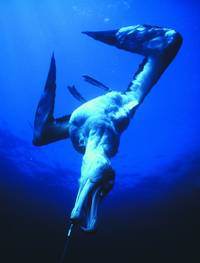
The albatross agreement requires signatory states to take specific measures to reduce seabird by-catch from longlining, a fishing practice that is assessed to kill some 300,000 seabirds every year. More than 100,000 of these seabirds are albatrosses, thus causing all albatross species to face varying risks of extinction.
The agreement further requires signatory states to develop a wide-ranging action plan to tackle not just the threat of longline fishing but also eradication at breeding sites of introduced species such as rats and feral cats, reduction of disturbance and habitat loss and reduction of marine pollution.
The South African ratification of the agreement was of special importance - not only because it assured its entering into force - but also because South Africa's waters are home to important populations of four species of albatross.
South African albatrosses include the wandering and grey-headed albatross - both which are classified as Vulnerable - and the Indian yellow-nosed and sooty albatross - both endangered. South African Minister of Environment, Mohammed Valli Moosa, thus early indicated that his country was looking forward to becoming an active member of the albatross agreement.
- South Africa's albatrosses and petrels breeding at the Prince Edward Islands are now threatened by the effects of pirate longline fishing and recent studies by South African researchers show alarming trends in their populations, Mr Moosa told the 2001 Cape Town conference. "We hope the Agreement will help us and other countries to rid pirate fishing from our seas," he added.
The international conservation group BirdLife on Friday strongly welcomed South Africa's ratification of the agreement. BirdLife has been organising a "Save the Albatross" campaign for several years and has conducted much research on the poor situation of albatross populations.
BirLife research recently established that the number of seabirds killed by longlines is still increasing. "With many albatrosses sliding towards extinction, [the agreement's] entry into force comes not a moment too soon," commented Euan Dunn of the group.
Aldo Berruti, Director of BirdLife South Africa, was especially thrilled by his country's move. "Birdlife South Africa is delighted at South Africa's signing of [the agreement], which is an invaluable first step on the road to saving threatened albatrosses and petrels," said Mr Berruti.
BirdLife was now urging the UK, including its crucially important Overseas Territories, to ratify the treaty without delay - as well as France, Brazil, Chile and Peru. These five countries control the remaining territories crucial for the survival of albatrosses and petrels.
The UK has however signalled that, when it is to ratify the agreement, it will not be covering the British island territories where the albatrosses actually breed - principally in the southern parts of the Atlantic, Indian and Pacific Oceans.
afrol News - It is called "financial inclusion", and it is a key government policy in Rwanda. The goal is that, by 2020, 90 percent of the population is to have and actively use bank accounts. And in only four years, financial inclusion has doubled in Rwanda.
afrol News - The UN's humanitarian agencies now warn about a devastating famine in Sudan and especially in South Sudan, where the situation is said to be "imploding". Relief officials are appealing to donors to urgently fund life-saving activities in the two countries.
afrol News - Fear is spreading all over West Africa after the health ministry in Guinea confirmed the first Ebola outbreak in this part of Africa. According to official numbers, at least 86 are infected and 59 are dead as a result of this very contagious disease.
afrol News - It is already a crime being homosexual in Ethiopia, but parliament is now making sure the anti-gay laws will be applied in practical life. No pardoning of gays will be allowed in future, but activist fear this only is a signal of further repression being prepared.
afrol News / Africa Renewal - Ethiopia's ambitious plan to build a US$ 4.2 billion dam in the Benishangul-Gumuz region, 40 km from its border with Sudan, is expected to provide 6,000 megawatts of electricity, enough for its population plus some excess it can sell to neighbouring countries.










 front page
| news
| countries
| archive
| currencies
| news alerts login
| about afrol News
| contact
| advertise
| español
front page
| news
| countries
| archive
| currencies
| news alerts login
| about afrol News
| contact
| advertise
| español