


|
Morocco Economy - Development | Environment - Nature Moroccan fisheries threaten Mediterranean dolphins
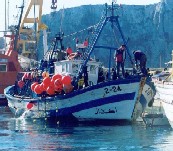
According to a new report, financed by WWF, a fleet of at least 177 small fishing vessels are engaged in the illegal driftnet fishing of swordfish. Official Moroccan records even put the number of vessels at 370.
The WWF researchers found that these results were pointing "to an unsustainable impact, especially for dolphins." More than 10 percent of the dolphin population size in the Alboran Sea was killed annually, which is far more than their reproduction rate. The Alboran Sea further housed the last remnant healthy population of dolphins in the whole of the Mediterranean. This "overfishing" of dolphins in Moroccan waters already seemed to have caused changes in the population. Genetic tests conducted in Spain had shown that the Alboran Sea dolphins now were closer related to Atlantic populations than to other Mediterranean populations. The decimated Alboran Sea population seemed to be constantly refilled with Atlantic individuals, entering through the Straits of Gibraltar. As for the Moroccan fishermen, the driftnet technique - that was introduced to catch swordfish some ten years ago - was producing declining profits. As swordfish populations were declining, fishermen only achieved average catches of 8.1 individual fishes per fishing operation and only 0.8 individuals per km of net set. It was obvious that the legal nets of 2.5 kilometres would not produce economically viable catches. Many fishermen, although using illegally long driftnets, already complain about the poor profitability of the activity. Al Hoceima fishermen interviewed by the researchers therefore said they "would be favourable to a complete transition toward other fisheries, abandoning driftnets, should public funds be available to support that." The team emphasised that "the necessary change in the fishing gear by the concerned fleet" should be made taking into account socio-economic and environmental factors. "Any restructuring towards another fi
Based on the report, WWF concludes that "the Moroccan driftnet fleet is the most lethal for Mediterranean marine biodiversity." The conservation group however stresses that also Italian, French, Turkish and most probably other fishing fleets were using driftnets in breach of existing legislation. The Italian driftnet fleet - with about 700 boats in the early 1990's - received subsidies from the EU for restructuring the fleet, but there are still up to 100 non-compliant boats. France (75 non-compliant boats), and Turkey (100) also have a sizeable driftnet fleet. - The evidence we have gathered on the Moroccan fleet brings us to think that illegal driftnet fishing currently happening in the whole Mediterranean results in a massive slaughter of vulnerable species, commented WWF's Paolo Guglielmi. "More than 4,000 kilometres of illegal nets from the Moroccan, French, Turkish and Italian driftnet fleets are ensnaring all that gets in their way," he added. WWF urged the EU to monitor and prosecute all the fleets of its member states using driftnets. The group further called non-EU countries, particularly those in North Africa, to introduce urgent legislation banning these nets. This call comes ahead of the Diplomatic Conference on Mediterranean Fisheries, to be held in Venice on 25 November. - The only valid way to prevent the massacre of dolphins, sharks and other marine species caused by these driftnet fleets in the Mediterranean is to make it a driftnet-free sea by enforcing a total ban on all the driftnet fisheries in the region, said Simon Cripps, Director of the Endangered Seas Programme. "The EU must urgently help all Mediterranean countries put in place plans to convert their driftnet fleets." By staff writer © afrol News - Create an e-mail alert for Morocco news - Create an e-mail alert for Economy - Development news - Create an e-mail alert for Environment - Nature news
On the Afrol News front page now
|







 front page
| news
| countries
| archive
| currencies
| news alerts login
| about afrol News
| contact
| advertise
| español
front page
| news
| countries
| archive
| currencies
| news alerts login
| about afrol News
| contact
| advertise
| español
©
afrol News.
Reproducing or buying afrol News' articles.
You can contact us at mail@afrol.com