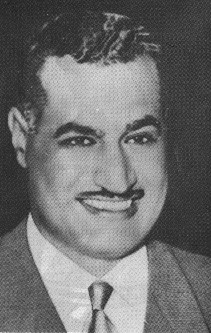
afrol News, 30 October - Fifty years ago, the Suez War started with a British and French-supported Israeli attack on Egypt, whose President Gamal Abd El-Nasser had nationalised the Suez Canal. The aggression - also termed the world's first oil war - ended in victory for Egypt, made Nasser an icon in the Arab world and hastened world-wide decolonisation.
Sunday marked the 50th anniversary of the tripartite attack on Egypt, known as the Suez War. The lessons from the war are more relevant than ever, as the Suez War was all about Western dominance of oil resources, false development promises, desires to topple a controversial regime and an attempt to stop a pan-Arabic movement. Only the actors were different.
On 29 October 1956, Israeli troops invaded the thus Egyptian Gaza Strip and the Sinai Peninsula, heading towards the Suez Canal. As previously agreed in a secret pact, Britain and France soon moved into Egypt to assist the Israelis. Egyptian troops were not in a position to raise effective resistance, leaving the way open for a relative quick military victory over President Nasser's government.
However, it did not come that way, as the Soviet Union threatened to assist Egypt and attack London and Paris. US President Dwight Eisenhower thus threatened Europe's great powers with economic sanctions should they not pull out of Egypt, leading to a quick French and British decision to withdraw and further leading to the final end of these European powers' grip on the globe.
The conflict had its roots in increasing hostilities between Israel and Egypt - which supported the oppressed Palestinian people - and a growing distance between President Nasser and Western powers.
Paris was at loggerheads with the Egyptian leader - who was a pan-Arab nationalist - because Mr Nasser supported the Algerian independence movement. London, which still kept Arab colonies, was threatened by his propagation of Arab nationalism. And the US and Western Europe were at unease over Mr Nasser's growing military ties with communist nations.
The Cairo government, on the other hand was devoted to quick development based on Western capital. As the US and Britain went back on their promises to co-finance the large Nile dam at Aswan, President Nasser decided to seek other financial sources. The answer was near and logical - the Suez Canal going through Egypt was one of the world's most important waterways but so far, most revenues from the French-built canal ended up in British companies.
On 26 July 1956, therefore, President Nasser announced the nationalisation of the Suez Canal Company, despite a majority foreign ownership. For the British government of Prime Minister Anthony Eden, this meant a threat to British capital, but most importantly to the British-controlled oil exports from the Arabian Peninsula. Also France saw most of its oil imports passing through the Suez Canal.
During the next months, war mongering dominated the scene in the UK and France. There were US attempts to mediate, but the Western demands went too far for the Cairo government. Understanding that the nation was heading towards war, President Nasser on 15 September in a famous speech warned: "We shall defend our freedom and independence to the last drop of our blood. This is the stanch feeling of every Egyptian."
The military operations in late October were short-lived. Militarily backward, Egypt was heading towards a total defeat. Only the threats from the Soviet Union and the US, together with the simultaneous crisis in Hungary, turned the tide. All sides later declared their victory, but historians now concede the military victory to Israel - which proved its military superiority in the Middle East - and the general victory to President Nasser.
As a result of the cease-fire, Egypt indeed only was obliged to make one important concession, which was stopping its blockade of the Straits of Tiran for Israeli ships. President Nasser could go on with his nationalisation of the Suez Canal, paying out foreign interests and get control of the foreign currency earner. So, the Aswan Dam became a reality and further nationalisations went ahead.
For the British and the French, the Suez War became a bitter defeat. Prime Minister Eden had to step down, and never admitted that the war decision had been wrong. Cairo thus did not restore diplomatic ties with London until 1969. France - whose aggressive true role did not become known until 1998 - admitted errors and soon normalised ties with Egypt.
The Suez War is probably the one small-scale war that had the most wide-ranging consequences world-wide in the 20th century. It marked the final point of France's and Britain's role of world powers, as none of them would act aggressively without coordinating with Washington later on. It also marked the beginning of France's distrust of Washington as an unreliable allied.
For the rest of the world, the indirect impact was even greater. The Suez War strengthened the United Nations and the role of smaller states in world politics. The UN condemned the attack on Egypt, strongly contributing to the British-French withdrawal. Further, the institution of UN peacekeepers was introduced to oversee the cease-fire between Egypt and Israel. Finally, the UN gained momentum in its drive for decolonisation, contributing to the establishment of African states.
President Nasser not only became an icon of the Arab world. He is also still celebrated as one of the most important catalysts of decolonisation, which gave him a special place in the establishment of the Organisation of African Unity (OAU, now African Union) and the Non-Aligned Movement. This was mostly a result of the Suez War and his demonstration that it was possible to stand up against Western imperialism.
afrol News - It is called "financial inclusion", and it is a key government policy in Rwanda. The goal is that, by 2020, 90 percent of the population is to have and actively use bank accounts. And in only four years, financial inclusion has doubled in Rwanda.
afrol News - The UN's humanitarian agencies now warn about a devastating famine in Sudan and especially in South Sudan, where the situation is said to be "imploding". Relief officials are appealing to donors to urgently fund life-saving activities in the two countries.
afrol News - Fear is spreading all over West Africa after the health ministry in Guinea confirmed the first Ebola outbreak in this part of Africa. According to official numbers, at least 86 are infected and 59 are dead as a result of this very contagious disease.
afrol News - It is already a crime being homosexual in Ethiopia, but parliament is now making sure the anti-gay laws will be applied in practical life. No pardoning of gays will be allowed in future, but activist fear this only is a signal of further repression being prepared.
afrol News / Africa Renewal - Ethiopia's ambitious plan to build a US$ 4.2 billion dam in the Benishangul-Gumuz region, 40 km from its border with Sudan, is expected to provide 6,000 megawatts of electricity, enough for its population plus some excess it can sell to neighbouring countries.










 front page
| news
| countries
| archive
| currencies
| news alerts login
| about afrol News
| contact
| advertise
| español
front page
| news
| countries
| archive
| currencies
| news alerts login
| about afrol News
| contact
| advertise
| español