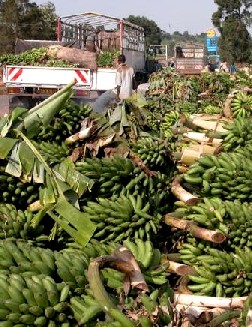
afrol News, 12 February - Over 70 million people in the East African highlands depend on banana as their primary source of food and income. With just a "minimal use" of fertilisers, they could easily double their yields, a new study finds. The results are said to be applicable for all Africa.
The International Institute of Tropical Agriculture (IITA) this week presented a fertiliser-use study on East African highland bananas with promising results.
The study found that majority of the banana growers in the region do not use fertilisers at all. Growers thus, they conclude, were missing out on the opportunity to maximise the crop's food security and economic potentials. Even a "moderate application of mineral fertilisers could double the production of the crop," field studies had shown.
The IITA was carried out in nearly 200 farmer fields in Uganda - the second largest producer and consumer of bananas in the world - demonstrating how modest fertiliser use can significantly increase the crop's yield. "In Central Uganda, for example, annual yields doubled from 10 to 20 tonnes per hectare with modest fertiliser application," the study said.
The research was led by Piet van Asten, IITA agronomist based in Uganda, and Lydia Wairegi, a PhD student at Makere University. "The application of fertilisers not only increases bunch weight but also shortens the crop cycle so the plants produce more bunches in a year", says Mr van Asten.
However, the study also found that less than 5 percent of the farmers apply fertiliser on their banana crop. The farmers cited high costs, erratic supply, and inconvenient packaging as the main reasons for not using fertilisers. They also indicated the lack of access to credit facilities, limited knowledge on fertiliser use, and the perceived negative effect on soil quality and on the taste of the bananas.
To debunk the latter, a related farmer sensory evaluation conducted by IITA and Uganda's National Agricultural Research Organization (NARO) showed that fertiliser use not only increased yields, but also improved the quality of the fruit to make matooke - a popular local delicacy made from steamed bananas.
The results of the evaluation indicated that fertiliser treatment actually improved the appearance, odor, texture, and overall acceptability of the steamed bananas, the scientists report.
Although the study showed proof of the positive effect of fertilisers on banana production, Mr van Asten cautions that fertiliser use has to be very strategic. For example, the practice only becomes more profitable when it is specific to a crop and a region, and targeted at only those nutrients that are most deficient.
"Most farmers follow blanket fertiliser recommendations which can be very inefficient and therefore expensive. Farmers should apply only as much nutrient as needed for a realistic yield increase for their specific locality," he emphasises.
He adds that another consideration is distance to the markets. "Bananas are perishable and costly to transport because of their bulkiness. One needs to be close to the market to fetch a really good price," he says. "Uganda's production zones are too far from markets, some more than 150 kilometres away. This leads to low banana prices at the farm gate. Fertiliser use in such cases becomes risky and, therefore, may not be recommended."
The study indicates that the Ugandan results are applicable for most regions of Africa where bananas are grown as use of fertilisers remain seldom on banana farms all over the continent. But different regions and different soils would need different types of fertilisers - to be mapped by a soil specialist - for maximum yield results.
afrol News - It is called "financial inclusion", and it is a key government policy in Rwanda. The goal is that, by 2020, 90 percent of the population is to have and actively use bank accounts. And in only four years, financial inclusion has doubled in Rwanda.
afrol News - The UN's humanitarian agencies now warn about a devastating famine in Sudan and especially in South Sudan, where the situation is said to be "imploding". Relief officials are appealing to donors to urgently fund life-saving activities in the two countries.
afrol News - Fear is spreading all over West Africa after the health ministry in Guinea confirmed the first Ebola outbreak in this part of Africa. According to official numbers, at least 86 are infected and 59 are dead as a result of this very contagious disease.
afrol News - It is already a crime being homosexual in Ethiopia, but parliament is now making sure the anti-gay laws will be applied in practical life. No pardoning of gays will be allowed in future, but activist fear this only is a signal of further repression being prepared.
afrol News / Africa Renewal - Ethiopia's ambitious plan to build a US$ 4.2 billion dam in the Benishangul-Gumuz region, 40 km from its border with Sudan, is expected to provide 6,000 megawatts of electricity, enough for its population plus some excess it can sell to neighbouring countries.










 front page
| news
| countries
| archive
| currencies
| news alerts login
| about afrol News
| contact
| advertise
| español
front page
| news
| countries
| archive
| currencies
| news alerts login
| about afrol News
| contact
| advertise
| español