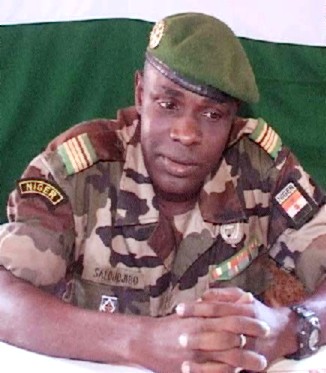
afrol News, 16 March - The putschists of Niger so far are living up to their promises to re-establish democracy in the country. Having announced junta members will not be eligible candidates for elections, Niger's new leaders have now engaged civil society in talks.
The Nigerien public is still generally happy with and confident in the new military leadership. Even the junta's approach to a surfacing famine in the country is strongly applauded as a contrast to ex-President Mamadou Tandja's handling of earlier food crises.
Having registered a rapidly increasing food insecurity due to drought, the Niger junta issued an international famine warning with an appeal for food aid. The Nigerien independent weekly 'La Griffe' hailed the junta for "breaking with Tandja's taboo system," referring to the ex-President's repeated denials of food insecurity. "Who would have thought this to be possible," the newspaper comments junta leader Salou Djibo's pronouncing of the word "famine". Under President Tandja, this could have sent the squadron leader to jail, it adds.
While the junta still is widely popular in Niger, the international community has its doubts. The African Union (AU) and Western donors demand the junta to release still detained ex-President Tandja, a move proving difficult as an exile home for Mr Tandja still has to be found.
More important, the AU says it is now time to announce the duration of the transition period and present a timetable for elections. Only this could prove the junta's termination to restore the constitutional order.
But the junta has already given strong proof it is serious when it comes to the democratic transition process. Last week, junta leader Djibo decreed that members of the ruling Supreme Council for the Restoration of Democracy (CSRD) would be banned from presenting their candidacy at the upcoming elections. It was a clear message to fellow junta members not to start thinking about holding on to power.
Regarding a timetable for transition, the junta holds it is too soon. Mr Djibo says this must be up to the yet-to-be Advisory Council. The council is to be set up by representatives of political parties, trade unions, associations and civil society. This council must be given the time to engage all stakeholder and parts of society, thus deciding hold long the junta is needed in power, according to the junta leader.
In Niger, most agree with this point of view. Nigerien media are supportive, mostly saying the Advisory Council must be given time. There is a fear that a too short transition period only will allow the old structures under ex-President Tandja to reclaim power.
The junta has already taken steps to form the council. Yesterday, junta leader Djibo met with representatives of trade unions and civil society in Niamey. There, he invited civil society to come up with "analyses and proposals regarding the conduct of the transition process." In an open debate, demands were presented Mr Djibo to pay workers outstanding salaries, include women in government and renegotiate mining contracts, among others.
The Nigerien press so far has published mostly positive articles about the ruling junta, mostly due to editors' relief over the fall of the Tandja regime. A real test about press freedom in the new Niger has yet to be produced, but so far freedom of expression seems to be largely respected and media refer freely to foreign condemnation of the coup. Expressions by potential opposition groups at this stage, however, are mostly directed at establishing a working relationship with the new rulers.
But there have been setbacks. Yesterday, Mr Tandja's former spokesman and Information Minister, Moctar Kassoum, was arrested for having publically demanded the release of the detained ex-President. The Tandja issue has become the new taboo in Niger - not a good sign.
afrol News - It is called "financial inclusion", and it is a key government policy in Rwanda. The goal is that, by 2020, 90 percent of the population is to have and actively use bank accounts. And in only four years, financial inclusion has doubled in Rwanda.
afrol News - The UN's humanitarian agencies now warn about a devastating famine in Sudan and especially in South Sudan, where the situation is said to be "imploding". Relief officials are appealing to donors to urgently fund life-saving activities in the two countries.
afrol News - Fear is spreading all over West Africa after the health ministry in Guinea confirmed the first Ebola outbreak in this part of Africa. According to official numbers, at least 86 are infected and 59 are dead as a result of this very contagious disease.
afrol News - It is already a crime being homosexual in Ethiopia, but parliament is now making sure the anti-gay laws will be applied in practical life. No pardoning of gays will be allowed in future, but activist fear this only is a signal of further repression being prepared.
afrol News / Africa Renewal - Ethiopia's ambitious plan to build a US$ 4.2 billion dam in the Benishangul-Gumuz region, 40 km from its border with Sudan, is expected to provide 6,000 megawatts of electricity, enough for its population plus some excess it can sell to neighbouring countries.










 front page
| news
| countries
| archive
| currencies
| news alerts login
| about afrol News
| contact
| advertise
| español
front page
| news
| countries
| archive
| currencies
| news alerts login
| about afrol News
| contact
| advertise
| español