See also:
» 31.03.2011 - Libya's Foreign Minister defects
» 24.03.2011 - How cyber-activism lent savvy to North African protests
» 18.03.2011 - Ten nations ready to attack Ghaddafi regime
» 18.03.2011 - Africa defies AU chief's support for Ghaddafi
» 18.03.2011 - France: We can start bombing Libya tonight
» 17.03.2011 - Libya rebels shoot down fighter jets
» 15.03.2011 - Ghaddafi thanks Germany, Russia and China
» 15.03.2011 - Libya rebels hold key city Ajdabiya


Libya
Politics

Libya peace very fragile, warns UN

Tarek Mitri, the head of the UN Support Mission in Libya, speaking at the Security Council

© afrol News/UN Photo/Evan Schneider
afrol News, 29 January
- The newest report on the situation in Libya concludes on dramatic challenges for the North African country. State-building reforms are going to slow, endangering stability, and the Mali conflict may spill over to Libya, the UN warns.

Tarek Mitri, the head of the UN Support Mission in Libya (UNSMIL), briefed the UN Security Council on developments in the country. While praising the new government of Prime Minister Ali Zeidan, in office since 14 November, Mr Mitri's report mainly focused on challenges and dangers.

In particular the fragile security situation in Libya was of concern for Security Council members. One member, the UK, has already urged all Western citizens to evacuate Benghazi, Libya's second city, over intelligence reports a terrorist attack may be imminent.

Mr Mitri confirms these security concerns, especially highlighting the fragile situation in Benghazi and the vast south of the country, where government seems to lack control of the situation.

He also drew up a new and grave security concern: "Security along Libya's borders also remained a concern," Mr Mitri said, "particularly given the possible impact of recent developments in Mali."

As the Islamists, originally armed after the collapse of the old regime in Libya, are driven out of Mali's cities by French troops, they are fleeing into the Sahara desert. There are concerns they will seek to establish new strongholds on territories where state control is lacking or minimal.

Southern Libya currently fits that picture best and is also close to the conflict area of northern Mali. "Discontent among the population in the south has increased with accusations of insufficient service delivery," Mr Mitri said. Southern parliament members temporarily walked out of the Libyan General National Congress and it is questionable how much c

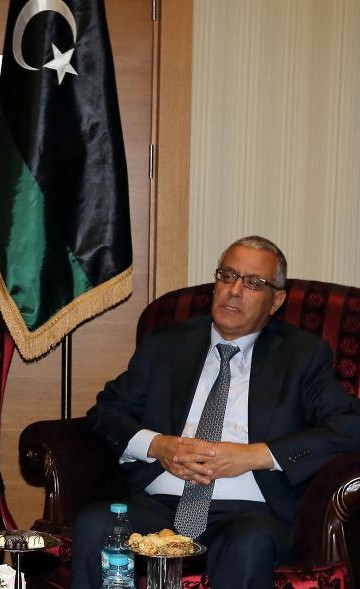
Libyan Prime Minister Ali Zeidan

© Mahmud Turkia/France Diplomatie/afrol News
ontrol the Tripoli government has over the southern desert part of the country.

In addition to threats of foreign insurgencies and local militias, the UN representative highlighted the threats to stability by the slow paste of state-building reforms. The transition process in Libya is going too slow, adding to security problems in the extensive country.

"It is worth insisting that many difficult decisions have yet to be taken in the areas of constitution-making, transitional justice, reconciliation and, it goes without saying, security sector reform," Mr Mitri insisted.

Pressure has been mounting for progress in the constitution-making process but parliament has not yet determined whether the members of the constitution-drafting body are to be appointed or elected, "an issue intertwined with regional politics," Mr Mitri said.

On the positive side, Mr Mitri said that recently installed Prime Minister Zeidan "appeared to enjoy broad support from the elected legislature, the General National Congress, political parties and the public." Also, security reform had gained momentum, with over 20,000 revolutionary fighters having enlisted with the Ministry of Interior's training process since security restructuring plans were announced in December.

Libya has been undergoing a transition toward a modern democratic state, after decades of autocratic rule and the toppling of the regime of Muamar al Ghaddafi. The former leader ruled the North African country for more than 40 years until a pro-democracy uprising in 2011 led to civil war and the end of his brutal regime.


- Create an e-mail alert for Libya news
- Create an e-mail alert for Politics news


    Printable version

On the Afrol News front page now


UN will not monitor human rights in Western Sahara

afrol News - The US has backed down on its demand that UN peacekeepers in Moroccan-occupied Western Sahara also shall monitor the human rights situation after Moroccan sources threatened to scale down relations with Washington.
Central African Republic
Central African Republic falling apart

afrol News - One month after the rebel movement Séléka took over power in the Central African Republic, unrest is spreading in the country. The new leader lacks control of his forces, which continue looting and abusing civilians.
Kenya
Kenyatta secures tight victory in Kenya

afrol News - The official election results in Kenya have finally been announced, and Uhuru Kenyatta managed to win the first poll round outright with a narrow 50.7 percent. But the main opponent, PM Raila Odinga, is filing a vote rigging complaint to the courts.
Cape Verde
Cape Verde to produce dragon fruit

afrol News - Cape Verde authorities have invested large sums to diversify the arid country's agricultural sector. Now, the dragon fruit, originating in tropical America, is being introduced for the first commercial production in Africa.
Egypt
Even governors in Pharaonic Egypt died in their 20s

afrol News - Researchers have analysed more than 200 mummies from ancient Egypt, finding that even high dignitaries were poorly nourished and had infectious diseases. The typical governor in Pharaonic Egypt died before he was 30 years old.


front page | news | countries | archive | currencies | news alerts login | about afrol News | contact | advertise | español 

©  afrol News. Reproducing or buying afrol News' articles.

   You can contact us at mail@afrol.com