afrol News, 3 May - In Equatorial Guinea, Libya and Eritrea, you will find no independent information hitting the streets. Governments in these three dictatorships are the most censoring in Africa, aiming at total control of the information that reaches citizens. This is shown in a report issued today, at World Press Freedom Day 2006.
The New York-based Committee to Protect Journalists (CPJ) today presented an analysis over the world's ten most censored countries, headed by North Korea, Burma and Turkmenistan. But also three African dictatorships make it to the top half of the CPJ list: Equatorial Guinea, Libya and Eritrea. Here, state-sponsored censorship assures people have no access at all to independent information.
Print and electronic media in all ten countries are under heavy state control or influence. Some countries allow a few privately owned outlets to operate but most of these are in the hands of regime loyalists. In Libya and Eritrea, there are no independent broadcast or print media, an anachronism even by Middle East standards. Equatorial Guinea has one private broadcaster; its owner is the President's son, widely assessed as the heir to the "throne".
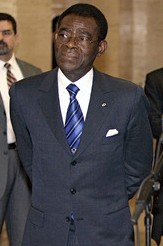
Most of the countries on CPJ's list are ruled by one man who has remained in power by manipulating the media and rigging any elections that are held. The media foster a cult of personality. State-run radio in Equatorial Guinea, for example, has described President Teodoro Obiang Nguema as "the country's God." Here is what CPJ found in Africa's three worst dictatorships:
Equatorial Guinea
Equatorial Guinea is known as the most oppressive dictatorship in contemporary Africa, with all powers in the hands of President Obiang and his family. Criticism of President Obiang's brutal regime is not tolerated in the Spanish-speaking country. All broadcast media are state-owned, except for 'RTV-Asonga', the private radio and television network owned by the President's son, Teodorín Obiang Nguema. A handful of private newspapers officially exist but rarely publish due to financial and political pressure.
An exiled press freedom group ASOLPEGE-Libre says the only publication that appears regularly is a pro-government magazine published in Spain and financed by advertising revenue from companies operating in Equatorial Guinea, "mainly North American oil companies." The group says the government has forced all private companies to pay for advertising spots on state broadcast media. It describes state broadcasters as "pure governmental instruments in the service of the dictatorship, dedicated uniquely and exclusively to political narcissism and the ideological propaganda of the regime in place."
The US State Department reported in 2005 that foreign celebrity and sports publications were available for sale but no newspapers, and that there were no bookstores or newsstands. Foreign correspondents have been denied visas or expelled without official explanation.
Propaganda broadcasting is common. State-run 'Radio Malabo' broadcasts songs warning citizens that they will be crushed if they speak against the regime. During parliamentary elections in 2004, state media called opposition activists "enemies" of the state. State radio has described President Obiang as "the country's God" who has all power over men and things.
Libya
In Colonel Muammar Ghaddafi's Libya, a slow opening up towards the West has not influenced oppressive media politics. Libya's media are the most tightly controlled in the Arab world. The government owns and controls all print and broadcast media, an anachronism even by regional standards. The media dutifully reflect state policies and do not allow news or views critical of Mr Ghaddafi or the government.
Satellite television and the Internet are available to Libyans, but the government blocks undesirable political Web sites. The Internet is one of the few avenues for independent writers and journalists, but the risks are exceedingly high. Dayf al-Ghazal al-Shuhaibi, who wrote for London-based opposition Web sites, was found shot in the head in Benghazi last year. No one has been charged with the murder, which has sent an unmistakable message to would-be critics.
The Libyan leader has made it clear he will not tolerate a free press. In 1977, Mr Ghaddafi laid out his ideas for Libya's cultural revolution in The Green Book. On the press he wrote, "The press is a means of expression for society: it is not a means of expression for private individuals or corporate bodies. Therefore, logically and democratically, it should not belong to either one of them."
Eritrea
In Eritrea, President Isaias Afewerki during the last five years slowly has grabbed all powers without ever holding an election. Eritrea is by now the only country in sub-Saharan Africa without a single private media outlet. More than four years after a vicious crackdown shuttered a fledgling independent press, the government's repressive policies have left the Horn of Africa nation largely hidden from international scrutiny and with almost no local access to independent information.
Only a privileged few Eritreans have access to the Internet. The handful of foreign correspondents in the capital, Asmara, are subject to intensive monitoring by authorities.
Eritrea is also Africa's largest prison for journalists - at least 15 journalists have been jailed or otherwise deprived of their liberty. Most are held incommunicado in secret detention centres without charges. When CPJ sought information about the imprisoned journalists in late 2005, Information Minister Ali Abdou told 'Agence France-Presse', "It is up to us what, why, when, and where we do things."
afrol News - It is called "financial inclusion", and it is a key government policy in Rwanda. The goal is that, by 2020, 90 percent of the population is to have and actively use bank accounts. And in only four years, financial inclusion has doubled in Rwanda.
afrol News - The UN's humanitarian agencies now warn about a devastating famine in Sudan and especially in South Sudan, where the situation is said to be "imploding". Relief officials are appealing to donors to urgently fund life-saving activities in the two countries.
afrol News - Fear is spreading all over West Africa after the health ministry in Guinea confirmed the first Ebola outbreak in this part of Africa. According to official numbers, at least 86 are infected and 59 are dead as a result of this very contagious disease.
afrol News - It is already a crime being homosexual in Ethiopia, but parliament is now making sure the anti-gay laws will be applied in practical life. No pardoning of gays will be allowed in future, but activist fear this only is a signal of further repression being prepared.
afrol News / Africa Renewal - Ethiopia's ambitious plan to build a US$ 4.2 billion dam in the Benishangul-Gumuz region, 40 km from its border with Sudan, is expected to provide 6,000 megawatts of electricity, enough for its population plus some excess it can sell to neighbouring countries.










 front page
| news
| countries
| archive
| currencies
| news alerts login
| about afrol News
| contact
| advertise
| español
front page
| news
| countries
| archive
| currencies
| news alerts login
| about afrol News
| contact
| advertise
| español