See also:
» 29.01.2013 - Libya peace very fragile, warns UN
» 31.03.2011 - Libya's Foreign Minister defects
» 24.03.2011 - How cyber-activism lent savvy to North African protests
» 18.03.2011 - Ten nations ready to attack Ghaddafi regime
» 18.03.2011 - Africa defies AU chief's support for Ghaddafi
» 18.03.2011 - France: We can start bombing Libya tonight
» 17.03.2011 - Libya rebels shoot down fighter jets
» 15.03.2011 - Ghaddafi thanks Germany, Russia and China


Libya
Politics | Human rights | Economy - Development

Libya economy reveals basis for protests

Protesters took to the streets of Libya's second city Benghazi on 16 February

© Khaled Rahim/afrol News
afrol News, 16 February
- While the Libyan economy drowns in petrodollars and its "Great leader" Muammar al-Ghaddafi buys support abroad, almost half of its youth are unemployed. The non-oil sector is tiny.

Libya is the richest North African country. Counted in GDP per capita, Libya indeed is on an Eastern European level.

But that does not reflect the real economy of the average Libyan, with around half the population falling outside the oil-driven economy. The unemployment rate is at a surprising 30 percent, with youth unemployment estimated at between 40 and 50 percent. This is the highest in North Africa.

Also other development indicators reveal that little of the petrodollars have been invested in the welfare of Libya's 6.5 million inhabitants. Education levels are lower than in neighbouring Tunisia, which has little oil, and a surprising 20 percent of Libyans remain illiterate.

Also, decent housing is unavailable to most of the disadvantaged half of the population. A generally high price level in Libya puts even more strains on these households.

But the key of popular discontent is the lack of work opportunities, which strongly contrasts the Libyan image of a rich nation constantly propagated by the regime and its Soviet-style media.

The few options for ordinary Libyans include the police or armed forces, construction works and petty trade. But even here, contacts and corruption are needed to have a chance.

But how can this be in such a rich country? The answer is that the Libyan economy is totally driven by the oil sector, and that non-oil developments have focused on Mr Ghaddafi's megalomaniac projects. Both are dominated by foreign workers.

The International Monetary Fund (IMF) yesterday timely presented its newest indicators of the Libyan economy. According to these latest IMF data, Libya's exports in 2010 amounted to an impressive US$ 47.8 billion. Quite illustrating, out of this, US$ 46.3 billion were exports of oil and gas products.

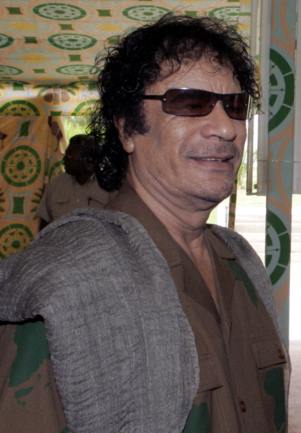
Libya's "Great leader" Muammar al-Ghaddafi

© Evan Schneider/UN Photo/afrol News


Libya's vast hydrocarbon sector creates an immense wealth, with government now having foreign assets of US$ 105 billion - or US$ 16,000 per Libyan citizen. But it does not create many jobs. A few Libyan businessmen, close to the Ghaddafi regime, and some Libyan engineers and oil workers make their living from oil and gas production. But foreign businessmen, engineers and workers are even deeper involved in the sector.

Libyan leader Ghaddafi for years has sought to diversify the economy by sudden launches of massive investments in giga-projects. A "Great Man-made River" was to create agricultural lands in the desert. First-class roads and high-speed trains were to cross the desert country in all directions to boost trade. Large tracts of Libya's Mediterranean coast have been set aside for massive tourist complexes.

These attempts to boost the non-oil sector have given some results on the paper. For most of the last five years, new IMF figures show, the non-oil sector has been growing much faster - with growth rates from 6 to 10 percent - than the hydrocarbon sector. It could seem that a diversification of Libya's economy was in the making, creating job opportunities for ordinary Libyans.

Not so. Most of the Libyan leader's megalomaniac projects are poorly assessed schemes not based in the development needs of the country or its population. Bluntly, they are mostly a waste of billions of dollars.

More importantly, they do not create work for ordinary Libyans. The giant projects are put to international tender, with foreign companies employing engineers and even bringing in the workforce to do the constructions. Even the food for these foreign workers is mostly imported.

The great railway scheme currently being implemented sees the sparsely populat

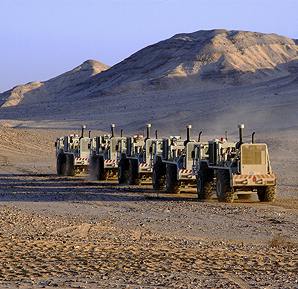
German engineers from RWE exploring oil reserves in Libya

© RWE/afrol News
ed country connected from east to west - the Egyptian border to the Tunisian border - with a high-speed train. Further, a line through the almost unpopulated Sahara desert is to be built. The projects went to a Chinese and a Russian railway company, providing all input and workforce.

Yesterday's IMF report, noting the high unemployment rate, in clear language says that the unrest across North Africa has not reached Libya "so far." According to the IMF, government was meeting these challenges by abolishing "taxes and custom duties on locally-produced and imported food products."

Further, it "announced the creation of a large multi-billion dollar fund for investment and local development that will focus on providing housing for the growing population," according to the IMF. New policies were aiming at "adapting the labour force to the economic transformation."

But among large parts of the Libyan population, the modest reform scheme introduced by Mr Ghaddafi - in power since 1969 - come too late and sound like empty words. Only one year ago, Libyan labour training chief Amin Mansour Amine had announced unemployment would be reduced by 50 percent during 2010 by the country's great infrastructure projects. Nothing however happened.

Meanwhile, the great social problems are adding up to political frustrations and an opposition to the dictatorship, especially in Libya's second city Benghazi. Inspired by the revolutions in Tunisia and Egypt, also a growing number of Libyans only see a solution in the total collapse of the Ghaddafi regime.

The first major protests against the Ghaddafi regime consequently were organised in Benghazi today. Several thousand protesters demanded the resignation of Mr Ghaddafi, but were met with riot police dispersing the crowds.


- Create an e-mail alert for Libya news
- Create an e-mail alert for Politics news
- Create an e-mail alert for Human rights news
- Create an e-mail alert for Economy - Development news


    Printable version

On the Afrol News front page now


UN will not monitor human rights in Western Sahara

afrol News - The US has backed down on its demand that UN peacekeepers in Moroccan-occupied Western Sahara also shall monitor the human rights situation after Moroccan sources threatened to scale down relations with Washington.
Central African Republic
Central African Republic falling apart

afrol News - One month after the rebel movement Séléka took over power in the Central African Republic, unrest is spreading in the country. The new leader lacks control of his forces, which continue looting and abusing civilians.
Kenya
Kenyatta secures tight victory in Kenya

afrol News - The official election results in Kenya have finally been announced, and Uhuru Kenyatta managed to win the first poll round outright with a narrow 50.7 percent. But the main opponent, PM Raila Odinga, is filing a vote rigging complaint to the courts.
Cape Verde
Cape Verde to produce dragon fruit

afrol News - Cape Verde authorities have invested large sums to diversify the arid country's agricultural sector. Now, the dragon fruit, originating in tropical America, is being introduced for the first commercial production in Africa.
Egypt
Even governors in Pharaonic Egypt died in their 20s

afrol News - Researchers have analysed more than 200 mummies from ancient Egypt, finding that even high dignitaries were poorly nourished and had infectious diseases. The typical governor in Pharaonic Egypt died before he was 30 years old.


front page | news | countries | archive | currencies | news alerts login | about afrol News | contact | advertise | español 

©  afrol News. Reproducing or buying afrol News' articles.

   You can contact us at mail@afrol.com