See also:
» 29.01.2013 - Libya peace very fragile, warns UN
» 31.03.2011 - Libya's Foreign Minister defects
» 24.03.2011 - How cyber-activism lent savvy to North African protests
» 18.03.2011 - Ten nations ready to attack Ghaddafi regime
» 18.03.2011 - Africa defies AU chief's support for Ghaddafi
» 18.03.2011 - France: We can start bombing Libya tonight
» 17.03.2011 - Libya rebels shoot down fighter jets
» 15.03.2011 - Ghaddafi thanks Germany, Russia and China


Libya
Politics | Human rights

Ghaddafi's control reduced to part of Tripoli

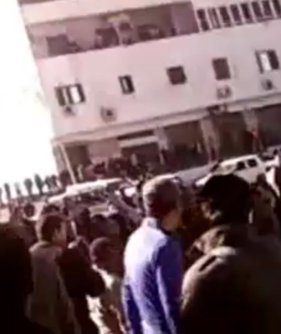
Residents in Misrata, Libya's third largest city, yesterday celebrated "liberation"

© Anonymous/afrol News
afrol News, 27 February
- As protests go on in the Libyan capital Tripoli, the regime is now only in control of a few neighbourhoods in the city. Except Sirte and the Sabha Oasis, the entire country is in the protesters' hands.

Renewed fighting in some Libyan cities yesterday and today has eliminated the last pro-regime resistance, local sources report. The revolution therefore has consolidated its firm grip on Misrata, Libya's third largest city, and Zawija, located only 50 kilometres west of Tripoli.

Also in Tripoli, most neighbourhoods are now under control of the protesters, despite occasional - but steadily fewer - attacks from armed forces. Especially working class neighbourhoods, such as Fashloom and Souk Juma, now are trying to consolidate their victories against pro-Ghaddafi troops.

Tripoli suburb Tajura, also a district dominated by workers and the lower middle class, now seems firmly in control of the protesters, except for the occasional short attacks from armed units. Tajura has been the main entrance to Tripoli protesters from outside the capital, reinforcing the protest movement.

Even Tripoli International Airport is only partly under the regime's control, with an increasing number of reports speaking of a complete chaos at the airport. Protesters however have shown restraint in the airport area, allowing for foreigners to evacuate the country.

Central Tripoli remains a battle zone, with waves of protesters sudenly appearing, until vehicles with pro-regime forces hunt them down shooting with live ammunition. None of the parties therefore is in control of most parts of the city.

The only parts of Tripoli firmly under the regime's control are some military bases and the upper class residential area where also the Ghaddafi family lives. Other residents in this neighbourhood have

Residents of Tripoli's working class district Fashloom for the core of protesters in the capital

© Anonymous/afrol News
reported that they would want to participate in the protests, but that streets are constantly guarded by armed troops.

The few areas under the regime's control now seem like fortresses, temporarily protecting the regime from its unavoidable collapse. "Ghaddafi is turning into the dictator without a land," Germany's journal 'Der Spiegel' commented.

Outside these few parts of Tripoli, there are only two laces still mostly in control of the regime. This especially includes the coastal city of Sirte, the birth-place of Colonel Ghaddafi. Protesters in Sirte last week had taken control of the city, but were later driven back by troops loyal to the regime.

Sirte is a strategic city on the route between the "liberated" east of Libya and Tripoli. The regime's control over Sirte prevents forces from "liberated" Benghazi from reaching Tripoli and keeps forces in nearby Misrata on high alert over possible attacks, thus also preventing them from helping to "liberate" Tripoli.

The last region still mostly loyal to the Ghaddafi regime is the Fezzan in the south-western desert part of the country. This isolated Berber and nomad region, with a significant part of Libya's oil resources, so far has been mostly calm. However, there have been unconfirmed reports of some unrest in the Sabha Oasis and Ghadames today, challenging the regime.

Especially the Sabha Oasis, the largest settlement in the vast Fezzan region, is seen as important to the Ghaddafi regime, as its military base and airport is said to regularly fly in "mercenaries" - or kidnapped sub-Saharan Africans - to the capital.


- Create an e-mail alert for Libya news
- Create an e-mail alert for Politics news
- Create an e-mail alert for Human rights news


    Printable version

On the Afrol News front page now


UN will not monitor human rights in Western Sahara

afrol News - The US has backed down on its demand that UN peacekeepers in Moroccan-occupied Western Sahara also shall monitor the human rights situation after Moroccan sources threatened to scale down relations with Washington.
Central African Republic
Central African Republic falling apart

afrol News - One month after the rebel movement Séléka took over power in the Central African Republic, unrest is spreading in the country. The new leader lacks control of his forces, which continue looting and abusing civilians.
Kenya
Kenyatta secures tight victory in Kenya

afrol News - The official election results in Kenya have finally been announced, and Uhuru Kenyatta managed to win the first poll round outright with a narrow 50.7 percent. But the main opponent, PM Raila Odinga, is filing a vote rigging complaint to the courts.
Cape Verde
Cape Verde to produce dragon fruit

afrol News - Cape Verde authorities have invested large sums to diversify the arid country's agricultural sector. Now, the dragon fruit, originating in tropical America, is being introduced for the first commercial production in Africa.
Egypt
Even governors in Pharaonic Egypt died in their 20s

afrol News - Researchers have analysed more than 200 mummies from ancient Egypt, finding that even high dignitaries were poorly nourished and had infectious diseases. The typical governor in Pharaonic Egypt died before he was 30 years old.


front page | news | countries | archive | currencies | news alerts login | about afrol News | contact | advertise | español 

©  afrol News. Reproducing or buying afrol News' articles.

   You can contact us at mail@afrol.com